G-04 Comparative assertion for building or product LCA

Aspect G-04 Comparative assertion for building or product LCA

Description
Comparative assertion is an environmental claim regarding the superiority or equivalence of one building product (or one building design) compared with a competing building product (or an alternative building design) that performs the same function. Usually, the comparison of alternative products, systems or buildings is the main goal of a comparative LCA study. Different aspects have to be taken into account to conduct a meaningful and robust comparative assertion. One of these is the functional equivalence between the systems under comparison (see the ‘functional equivalent’ aspect), but there are other aspects that need to be considered, such as the system boundary, the background database, the life cycle inventory, and the life cycle impact assessment methodology applied.
How can a comparative assertion be made in building LCA applications?
Related study
objective
☐ stand-alone LCA ☒ comparative assertion
Related study
phase
☒
goal and scope definition
☐
inventory analysis (LCI)
☐
impact assessment (LCIA)
☐
interpretation
☐
reporting
Relevant for
new buildings

existing buildings

construction products

screening LCA

simplified LCA

complete LCA

Provisions
In a comparative study, it must be ensured that the systems being compared are equivalent in function. According to ISO 14044 and ILCD, the same functional unit, system boundary, data quality requirements and allocation procedures have to be applied.
EN 15978 provides the practitioner with rules to be considered in the comparison of two buildings. The comparison also has to use the same environmental indicators, using those defined in the standard and in the ILCD Handbook.
The provisions of EN 15804 may be used under very specific conditions to compare cradle-to-grave product alternatives (cf. guidance).

Rules from
EN 15978 Purpose of the assessment
EN 15978 states that it can be used for “assistance in a decision-making process, for example: comparisons of the environmental performance of different design options”.
EN 15804 5.1 Objective of the PCR
EN 15804 states that the “declarations based on this standard are not comparative assertions.”
ISO 14040 4.3 Key features of an LCA
5.2 Goal and scope definition
6 Reporting
7.2 Need for critical review
ISO 14044 4.2.2 Goal of the study
4.2.3 Scope of the study
4.2.3.7 Comparison between systems
4.4.5 LCIA intended to be used in comparative assertions intended to be disclosed to the public
5.3 Further reporting requirements for comparative assertion intended to be disclosed to the public
ILCD 6.10 Comparison between systems
6.10.3 Considered alternatives, the functional unit, and assumptions
6.10.4 Methodological, assumptions and data consistency
6.10.5 Data quality requirements
6.10.6 Identical parts of the compared systems
6.10.7 Scenarios in support of comparisons
6.10.8 Carbon footprint studies and other selected comparisons

Main provisions for all comparative studies (summary of the ILCD Handbook):

  • I) ISO 14044:2006 provisions for comparison assertions shall also be applied to non-assertive comparative studies.
  • II) All aspects of the goal and scope definition shall be addressed consistently especially for: LCI model, assumptions, data quality.
  • III) Uncertainty and accuracy calculation shall support this analysis.
  • IV) The completeness/cut-off (in%) shall be met for mass and energy, next to the overall environmental impact.
  • V) The excluded processes that are identical for all alternatives may be left out of all models.
  • VI) An LCIA shall be performed for LCA studies intended to support comparative studies (for public communication).
  • VII) If only one impact category (e.g. carbon footprint) is considered for those studies, it shall highlight that the comparison is not suitable to identify environmental preferable alternatives.

Main provisions for studies with similar functional equivalent (summary of the ILCD Handbook):

  • VIII) The compared systems shall have the same functional unit.
  • IX) The study should include potentially environmentally better market relevant and available alternatives.
  • X) The selected functional unit should reflect well-justified typical or average production/operation/use scenarios.
  • XI) If the system needs to be replaced to meet the required duration of performance, the replacement should consider that potentially a newer system will replace the initially used model.
  • XII) For comparative micro-level studies (Situation A), each compared scenario shall be complemented with assumption scenarios of reasonably best and worst cases.
  • XIII) For comparative meso/macro-level (situation B): the scenarios for each of the analysed alternatives shall apply the modelling guidance of situation A.
  • XIV) Involvement of interested parties in review.

Guidance
For building LCA applications, comparative assertions are typically conducted to choose among design alternatives.

The major focus of the LCA practitioner has to lie on defining two alternatives that are truly comparable. Therefore special attention should be directed to identifying all functions that a design alternative has. This may include technical functions, e.g. structural functions, and building physical functions, such as ensuring specified quality levels of the indoor environment, but also architectural and aesthetic functions. Therefore design alternatives should always be agreed within the planning team, including the architect, structural engineers, building physics and energy performance experts. If the functions of two design alternatives are not truly comparable, the planning team should identify additional solutions to ensure comparable features, and these should be included in the comparative LCA study.

Users who are not LCA experts typically use dedicated LCA tools for comparing their building’s design alternatives. Such tools may support the choice of adequate – comparable – design alternatives, and assist in conducting the LCA study, especially with regard to the comparability of background data, etc.

1) Practical guidance when comparing building design alternatives
Because design software contains built-in methodological decisions (functional unit, system boundaries, cut-off criteria, etc.), as well as built-in databases, it is generally important not only to apply generally uniform methodological decisions, but also to use the same software when comparing two building design alternatives.

Concerning the background database used for the comparative assertions, the user can look at the methodological report or user manual of the LCA software for buildings to check for consistency according to the ILCD handbook.

2) Comparative assertion for product LCA based on EN 15804 in E2B EI research projects
Under specific conditions, it may be possible to compare a regular product and an innovative product following EN 15804 provisions, if the product model is from cradle to grave. All the other provisions of EN 15804 should be applied, if necessary, to comply with the comparative assertion rules according to ILCD; otherwise use the ILCD provisions if no provisions exist in the EN 15804 standard.

G-05 Scope definition for building and product LCA

Aspect G-05 Scope definition for building and product LCA

Description
According to [ISO 14040], [ISO 14044], and the ILCD Handbook, the scope definition of a study is the step where the main requirements related to methodology, quality, reporting and review in accordance with the goal of the study (i.e. based on the reasons for the study), the decision context, the intended applications, and the addressees of the results [ILCD 2010c] are stated. Examples of requirements include the function, functional unit and reference flow definitions, derivation of system boundaries, and cut-off criteria (completeness).
How can the practitioner set up the scope of the study? Are there special cases where the effort of scope definition can be simplified in regard to product or building LCAs?
Related study
objective
☒ stand-alone LCA ☒ comparative assertion
Related study
phase
☒
goal and scope definition
☐
inventory analysis (LCI)
☐
impact assessment (LCIA)
☐
interpretation
☐
reporting
Relevant for
new buildings

existing buildings

construction products

screening LCA

simplified LCA

complete LCA

Provisions
The scope definition of a study should be defined according to the context and the intended use of the assessment.
The documentation should also be in line with ISO 14044, EN 15978 and EN 15804.

Rules from
EN 15978 6 Purpose of the assessment
7 Specification of the object of assessment
EN 15804 6.2 Life cycle stages and their information modules to be included
6.3 Calculation rules for the LCA
ILCD 6 Scope definition – what to analyse and how
Provisions 6.2.1 Consistency of methods, assumptions, and data
Provisions 6.2.2 Reproducibility
Provisions 6.3 Types of LCA deliverables and intended applications
Provisions 6.4 Function, functional unit, and reference flow
Provisions 6.5.4 LCI modelling provisions for situations A, B and C
Provisions 6.6 Deriving system boundaries and cut-off criteria
Provisions 6.7 Preparing the basis for the impact assessment
Provisions 6.8.2 Technological representativeness
Provisions 6.8.3 Geographical representativeness
Provisions 6.8.4 Time-related representativeness
Provisions 6.9 Types, quality and sources of required data
Provisions 6.10 Comparison between systems
Provisions 6.11 Identifying critical review needs
Provisions 6.12 Planning reporting
ISO 14044 4.2 Goal and scope definition

Guidance
1) General guidance for product or building LCA studies

This step is closely linked to the goal definition. It is recommended that the LCA practitioner does not start from ‘zero’, but rather follows EN 15804 and EN 15978 if the scope definition within these standards is relevant for the context of the study. If not, it is recommended that the ILCD guidance on how to define the different aspects of the scope be used (see the rules from ILCD).

2) Practical guidance for product and building LCA studies according to the scope definition of EN 15804/EN 15978

The scope of the study defines the various contributors to include in the LCA study, such as the building products (Modules A, B, C, D), construction site (Module A5), energy consumption (Module B6), water consumption (Module B7), and transport of people (during the use phase).

The inclusion of any module depends on the goal definition, the stage of the project, and the LCA practitioner. Generally speaking, all the provisions for scope definition in EN 15804 and EN 15978 should be applied.

3) Predefined scope of product and building LCA studies according to EeBGuide study types

The definition of the scope of a study within the context of this guidance is also broadly predefined through the study type (screening, simplified or complete LCA). Provisions for aspects such as the completeness of the assessment (e.g. adapted calculation rules, system boundaries and cut-off-criteria), data representativeness and type (e.g. use of default values), documentation and communication help the definition of the scope. The reporting templates of the EeBGuide also help regarding documentation of the goal and scope of an LCA study.

G-06 (Buildings) / G-07 (Products) Functional equivalent

Aspect G-06 (Buildings) / G-07 (Products) Functional equivalent

Description
According to [EN 15643-1], the functional equivalent is a representation of the required and quantified functional and/or technical requirement for a building or an assembled system (part of works), which is used as a basis for comparison. Usually, assessments of individual objects form part of the decision-making process regarding, for instance, whether to build a new building or refurbish an existing building, or which are the most appropriate design options. In such cases comparison should be made only on the basis of functional equivalents. For this reason, in comparative studies between different systems/options, it is essential to define the functional equivalent.How should the functional equivalent be correctly defined?
Related study
objective
☒ stand-alone LCA ☒ comparative assertion
Related study
phase
☒
goal and scope definition
☐
inventory analysis (LCI)
☐
impact assessment (LCIA)
☒
interpretation
☐
reporting
Relevant for
new buildings

existing buildings

construction products

screening LCA

simplified LCA

complete LCA

Provisions
At the building level, the functional equivalent should be defined with regard to EN 15978. It needs to include the building type, relevant technical and functional requirements, the pattern of use and the required service life. Other specific requirements or conditions may be relevant for inclusion in the information on the functional equivalent.
The functional equivalent concept may be used at the sub-building level. EN 15804 defines the rules for the functional unit to ensure that the comparison is consistent (e.g. for assembled systems or components). In such cases the basis for the comparison is the entire building, ensuring that the same functional requirements are met.

Rules from
EN 15978 7.2 Functional equivalent
EN 15804 6.3.2 Functional unit
5.3 Comparability of EPD for building products
ILCD Provisions: 6.4 Function, functional unit, and reference flow

  • I) SHALL – Identify system or process
  • II) MAY – Photos, specifications
  • III) SHALL – Identify function(s) and functional unit(s)
  • IV) SHALL – Functional unit, details
    • IV.a) Function provided (what)
    • IV.b) In which quantity (how much)
    • IV.c) For what duration (how long)
    • IV.d) To what quality (in what way and how well is the function provided)
  • V) MAY – Obligatory and positioning properties
  • VI) SHALL – Measurement methods
  • VII) SHOULD – Alternatives and complements to the functional unit
    • VII.a) Materials and other application unspecific products
    • VII.b) Monofunctional processes
    • VII.c) Multifunctional processes
  • VII) SHOULD – Highly variable function
  • VII) SHALL – Comparative studies

Guidance
In practice, a building has many different functions, and it is important to define correctly what is included in the functional equivalent. ISO and CEN standards dealing with the sustainability of buildings propose that the reference flow (which is conventionally called the ‘reference unit’) be differentiated from the functional unit (which is conventionally called the ‘functional equivalent’).

In EN 15978, the reference unit (i.e. the expression of the results in terms of m² or number of people) is differentiated from the functional equivalent, which includes various aspects related to the characteristics of the building. At the building level, EN 15978 defines the functional equivalent, whereas at the product level, EN 15804 defines the functional unit.

  • Example of the functional equivalent of a building:

Type of building: Office building; 4000 m² net floor area

Use: net floor area heated or cooled to specified temperature level

Relevant technical and functional requirements: heated and cooled rooms with a temperature range between 20°C and 26°C; air change rate of 30m³/(h*person); lighting level 300 lux; see also specifications in national standards.

Pattern of use: 200 workers; working time from 07.00 am till 06.00 pm, 5 days per week, 48 weeks per year.

Design service life: 50 years

  • Example of the functional equivalent of an assembled system:

Type of system: Transparent solar thermal collector

Use: production of thermal energy in kWh per façade area in m². Relevant technical and functional requirements: U-value of 1.0 W/(m²K); function as shading device, reducing solar gains inside the building;

Design service life: 20 years

More information regarding the definition of the functional equivalent is linked to benchmarking criteria. Such concepts are much more developed in another European project (FP7) called ‘SuPerBuildings’. Interested practitioners can look at the online deliverable D5.2 ‘Benchmarking criteria for sustainable buildings in Europe’ on the website of the project.

G-06 Distinction between the declared unit and the functional unit

Aspect G-06 Distinction between the declared unit and the functional unit

Description
The functional unit represents the quantified performance of a product system for use as a reference unit for the LCA study. It is the unit of scale or reference on which the LCA results are based, and relates to the given function of the product. In other cases, the functional unit should be defined according to the future use of the building. A functional unit comprises a function, a quantity, a duration and a quality. The declared unit is used instead of a functional unit when the precise function of the product at the building level is not stated or known, or when the LCA does not cover a full life cycle. It is necessary to distinguish between these two concepts for product LCA, and to give operational guidance.
Related
study objective
☒ stand-alone LCA ☒ comparative assertion
Related
study phase
☒
goal and scope definition
☐
inventory analysis (LCI)
☐
impact assessment (LCIA)
☐
interpretation
☐
reporting
Relevant for
new buildings

existing buildings

construction products

screening LCA

simplified LCA

complete LCA

Provisions
The practitioner should refer to EN 15804 and the ILCD Handbook for the correct definitions of the functional unit and the declared unit.

The declared unit should be used for raw materials that are not implemented directly in the building, and for non-application-specific products.

In other cases, the functional unit should be defined according to the future use of the building. A functional unit comprises a function, a quantity, a duration and a quality.

Under special conditions (e.g. if a building product has a rather large number of possible applications in a building), then the declared unit, as defined in EN 15804, may be more appropriate than the concept of the functional unit, as the functions provided by a construction product are often closely related to the way that the product is incorporated in the building, and this cannot be known at the point at which the product is assessed.


Rules from
EN 15804 6.3.1 Functional unit
6.3.2 Declared unit
ILCD Provisions: 6.4 Function, functional unit, and reference flowI) SHALL – Identify system or process

II) MAY – Photos, specifications

III) SHALL – Identify function(s) and functional unit(s)

IV) SHALL – Functional unit, details

         IV.a) Function provided (what),

         IV.b) in which quantity (how much),

         IV.c) for what duration (how long),

         IV.d) to what quality (in what way and how well is the function provided)

V) MAY – Obligatory and positioning properties

VI) SHALL – Measurement methods

VII) SHOULD – Alternatives and complements to the functional unit

         VII.a) Materials and other application unspecific products

         VII.b) Monofunctional processes

         VII.c) Multifunctional processes

VII) SHOULD – Highly variable function

VII) SHALL – Comparative studies

ISO 14044 4.2.3.2 Function and functional unit

Guidance
1) Specific guidance for defining the declared unitThere are two cases when it is relevant to define a declared unit. The first is for raw materials (e.g. cement, gravel) for which a functional unit does not really make sense. The second is for products that can be used in a wide variety of different or simultaneous functions in the building or construction works: for example, a timber section might be used in upper floor construction, in a partition wall, in fencing or in joinery. For each of these functions, the wastage in construction and the service life of the timber might be different. Similarly, a concrete block could be used in either an internal or an external wall, and with thin joint or normal mortar; each of these options will impact differently on the thermal performance of the block in the building or construction works. In this second case, a declared unit is used, allowing the relevant data to be provided and aggregated at the building level, where the function of the product as installed can be considered over the building life. Examples of declared units include:

  • by item, e.g. 1 brick, 1 window (dimensions to be specified), 1 lighting-fitting, 1 radiator;
  • by mass, e.g. 1 kg of cement;
  • by length, e.g. 1 m of pipe, 1 m of a beam (dimensions must be specified);
  • by area, e.g. 1 m2 of wall elements, 1 m2 of roof elements (dimensions must be specified);
  • by volume, e.g. 1 m3 of timber, 1 m3 of ready-mixed concrete.


2) Specific guidance for defining the functional unit

For product LCA (e.g. EPD), the functional unit has to be closely defined with the company that commissions the LCA or EPD study.

For cradle-to-gate and cradle-to-site product LCA data, the function of the product within the building or construction works is uncertain, and it is therefore not easy to find a functional unit, which needs to include information on the required functional performance of the product within the building or construction works over the full life cycle. Nevertheless, during discussions on the development of CEN TC 350 the recommended route was to identify reasonable scenarios and include information for one or more of these scenarios. In defining such a scenario, much of the required information to describe a post-gate life cycle stage would originate from the building, and would be related to the product being studied.

The functional unit has a quantity (e.g. 1 m²), a duration (e.g. ‘maintaining the function over 50 years’) and a quality e.g. ‘”to ensure a thermal resistance of 2 m²/W.K’). It is closely connected to the definition of the relevant service life of the product (cf. the corresponding aspect).

For comparative purposes, different, simultaneously applying functions may be relevant. With the definition of the functional unit, all relevant functions should be covered.

G-07 (Buildings) / G-08 (Products) Functional equivalent vs. functional unit vs. declared unit

Aspect G-07 (Buildings) / G-08 (Products) Functional equivalent vs. functional unit vs. declared unit

Description
ISO 14040, ISO 14044 and EN 15804 define a functional unit; EN 15804 also defines a declared unit. EN 15978 defines a functional equivalent. What are the differences, and when should which term be used?
Related study
objective
☒ stand-alone LCA ☒ comparative assertion
Related study
phase
☒
goal and scope definition
☐
inventory analysis (LCI)
☐
impact assessment (LCIA)
☒
interpretation
☐
reporting
Relevant for
new buildings

existing buildings

construction products

screening LCA

simplified LCA

complete LCA

Provisions
ISO 14040 and 14044, as the basic LCA standards, define the ‘functional unit’ as the quantification of the performance of a product system, and specify that it is used as the reference unit for the LCA and any comparative assertion.
The term ‘functional equivalent’ is defined in EN 15978 as denoting the technical characteristics and functionalities of the building that is being assessed.
The term ‘functional unit’, as defined in EN 15804, refers to the quantification of identified functions or performance characteristics of products. The function/performance characteristics of the product are defined at the building level. The functional unit is used primarily as the reference unit for the product LCA study.
The term ‘declared unit’ is specific to product LCAs, as defined in EN 15804. It is used instead of the ‘functional unit’ if the specific function of a product at the building level is not known. EN 15804 states that the declared unit shall be used if an LCA study does not cover the entire life cycle (‘cradle to grave’), but only certain modules (e.g. only ‘cradle to gate’).
The terms should be used in line with the definitions of the standards to allow for improved consistency of LCA studies within the construction sector.

Rules from
EN 15978 7.2 Functional equivalent
EN 15804 5.3 Comparability of EPD for building products
6.3.1 Functional unit
6.3.2 Declared unit
ILCD Provisions: 6.4 Function, functional unit, and reference flow

  • I) SHALL – Identify system or process
  • II) MAY – Photos, specifications
  • III) SHALL – Identify function(s) and functional unit(s)
  • IV) SHALL – Functional unit, details
    • IV.a) Function provided (what)
    • IV.b) In which quantity (how much)
    • IV.c) For what duration (how long)
    • IV.d) To what quality (in what way and how well is the function provided)
  • V) MAY – Obligatory and positioning properties
  • VI) SHALL – Measurement methods
  • VII) SHOULD – Alternatives and complements to the functional unit
    • VII.a) Materials and other application unspecific products
    • VII.b) Monofunctional processes
    • VII.c) Multifunctional processes
  • VII) SHOULD – Highly variable function
  • VII) SHALL – Comparative studies

Guidance
The distinction between functional unit, declared unit and functional equivalent is specific to the European construction sector, as they are defined in the CEN standards. LCA practitioners who are not thoroughly familiar with these standards may find it difficult to understand the details of this differentiation.

In general life cycle thinking, and for the practical purpose of conducting an LCA, the differences in definition and understanding are not critical to conducting an LCA study. All definitions essentially require the technical performance of the object of assessment to be quantified, and they require a comparative quantification for the case of comparative assertions and meaningful reference units, if the results of an LCA study are intended to be used elsewhere (e.g. the results of a product LCA to be used in a building LCA).

For practical application, it is recommended that the terminology of the standards be used. It is essential for the success of an LCA study to define the relevant functions carefully, and to identify the appropriate reference unit, as this is the essential basis for any comparison and/or reuse of LCA data.

G-09 Energy-efficient product definition

Aspect G-09 Energy-efficient product definition

Description
What is an energy-efficient product, and how is it characterized?
Study
objective
☒ stand-alone LCA ☒ comparative assertion
Study
phase
☒
goal and scope definition
☐
inventory analysis (LCI)
☐
impact assessment (LCIA)
☐
interpretation
☐
reporting
Relevant for
new buildings

existing buildings

building products

screening LCA

simplified LCA

complete LCA

Provisions
No specific definition is given. The LCA calculation rules must be appropriate for all building products.

Rules from:
EN 15804 The standard does not refer to energy-efficient products in particular, but the standard can be used to assess any product, component or element used in the building, including the assessment of building-integrated technical systems, as defined in 6.3.4.4.3.

6.3.4.4.3 B6–B7 use stage information modules related to the operation of the building:
B6 Energy use to operate building-integrated technical systems

CEN/TR 15615 Explanation of the general relationship between various European standards and the Energy Performance of Buildings Directive (EPBD) — Umbrella Document.

Guidance
An energy-efficient building can consist of a whole range of building products and technical equipment; many of the usual ones will not influence energy consumption in use. Conversely, an ‘energy-efficient’ product can be one that increases the energy efficiency of the whole building. However, in the EeBGuide there is no existing differentiation between these different types of product in terms of assessing their life cycle impact, and product LCA data can be provided for building services equipment such as heating, air conditioning, transportation and lighting.

Energy-using products (EuP) are now covered alongside energy-related products in the EcoDesign Directive.

Energy-related products (ErP) are products such as windows and insulation, or products with thermal mass, which have an impact on the energy use of the building, but do not directly use energy themselves, and which are not part of the building-integrated technical system. These are also covered by the EcoDesign Directive.

In all cases, the particular use of the products in the building, and the design of the building, are key to understanding the performance of the product, and the operational performance of the building can only be assessed at the building level.

G-10 Definition of system boundaries for products

Aspect G-10 Definition of system boundaries for products

Description
The system boundaries of product LCA can be different, depending on the goal and scope of the study. If the goal is to create an EPD, then the practitioner is likely to follow the EN 15804 standards. But even for EPD, the system boundaries can vary, depending on the type of data: cradle to gate, cradle to gate with options, or cradle-to-grave. For LCA used in ecodesign, it may be relevant to include the recycling potentials of the products, thus extending the system boundary (a cradle-to-cradle approach) – that is, including Module D if the study complies with EN 15804. Generally speaking, the main issue for any product LCA is to define what to include, especially for the production stage.

How can the system boundaries be defined for product LCA?

Study
objective
☒ stand-alone LCA ☒ comparative assertion
Study
phase
☒
goal and scope definition
☐
inventory analysis (LCI)
☐
impact assessment (LCIA)
☐
interpretation
☐
reporting
Relevant for
new buildings

existing buildings

building products

screening LCA

simplified LCA

complete LCA

Provisions
The practitioner should refer to the ILCD Handbook, or otherwise EN 15804, depending on the goal and scope of his study.

For LCA studies that are compliant with EN 15804, the practitioner should be aware that different system boundaries can be selected: cradle to gate, cradle to gate with options, or cradle to grave.

If the results are intended to be used for comparative assertions, then the rules used to define the system boundaries should follow the ILCD Handbook.


Rules from:
EN 15804 6.3.4 System boundaries
ILCD Provisions: 6.6 Deriving system boundaries and cut-off criteria (completeness)
“I) SHALL – Scope of LCA
II) SHALL – Processes within the system boundary
III) SHALL – Flows across the system boundary
IV) SHALL – System boundary diagram
V) SHALL – List of exclusions
VI) SHALL – part-system and system-system relationships
VII) SHALL – System-external off-setting
VIII) SHALL – Quantitative cut-off criteria”

Provisions: 7.2.3 Identifying processes in attributional modelling
“[…] I) SHALL – Identifying processes within the system boundary
   I.a) Start from central process
   I.b) Foreground system
   I.c) Background system
   I.d) Justify and document exclusion
II) SHALL – Initial processes description”

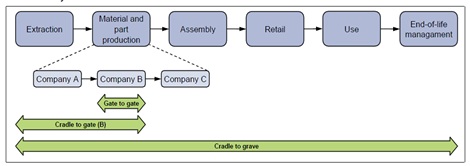
As an illustration for product LCA, the ILCD Handbook details the different life cycle stages to take into account and the different types of data. It has to be mentioned that the foreground data collection (based on e.g. measured data from company) takes place during the gate-to-gate stage (see below). For the other data (e.g. extraction processes), the data are likely to be based on background data.

Figure 11: Cradle-to-grave, cradle-to-gate and gate-to-gate datasets as parts of the complete life cycle


Guidance
Different cases can be found in practice. For EPD data, rules from EN 15804 should be applied. These types of EPD system boundary can be found, depending on the goal and scope (e.g. for 1 kg of declared unit for cement, the system boundaries will be only up to the gate of the plant).

For E2B EI research projects, product LCA studies may be conducted for the full life cycle. The practitioner is likely to collect foreground data for the gate-to-gate stage among the project partners (e.g. a company involved in the project that would like to assess its new product), whereas for upstream or downstream processes the use of generic data may be sufficient. This last recommendation is also in line with EN 15804.

G-12 (Buildings) / G-11 (Products) Cut-off rules for screening, simplified, complete LCA

Aspect G-12 (Buildings) / G-11 (Products) Cut-off rules for screening, simplified, complete LCA

Description
Cut-off rules enable LCA practitioners to conduct LCA without having to model 100% of the product system. According to the ILCD Handbook, the cut-off criteria refer to the omission of non-relevant life cycle stages, activity types, specific processes and products and elementary flows from the system model. Cut-off rules are quantified in relation to the percentage of environmental impacts that have been approximated to be excluded via the cut-off. The apparent paradox is that one must know the final result of the LCA to be able to know which processes, elementary flows etc. can be left out [ILCD, 2011a]. But, if one knew the 100% impacts of a product, then there would be no need for a cut-off. In practice, the total inventory is always unknown, but must be extrapolated from the measured or calculated data.What should the cut-off rules be for a product LCA or a building LCA?
Related study
objective
☒ stand-alone LCA ☒ comparative assertion
Related study
phase
☒
goal and scope definition
☐
inventory analysis (LCI)
☐
impact assessment (LCIA)
☐
interpretation
☐
reporting
Relevant for
new buildings

existing buildings

construction products

screening LCA

simplified LCA

complete LCA

Provisions
In general, ILCD provisions should be followed for the cut-off rules.
For product and building LCA studies complying with EN 15804 and EN 15978 goal and scope definition, the cut-off rules should be adopted.
For product and building LCA studies that comply with EeBGuide predefined study types, the cut-off rules should be adopted. They are defined to allow for a simplification of LCA, and in particular to reduce the complexity of the study.
For screening and simplified building LCA, the practitioner should refer to the list of building products and technical equipment to take into account. The others remain optional – to date – owing to potentially missing data. However, they may be included if default values exist for these building products or technical equipment at the European level.
For complete LCA studies, cut-off rules should be applied primarily according to the ILCD Handbook, but if this is not achievable in practice, they may be applied according to EN 15804/EN 15978 (in this case, the study type is not entirely a complete LCA).

Rules from
EN 15978 7.4.3 Criteria for the exclusion of inputs and outputs
EN 15804 7.3.5 Criteria for the exclusion of inputs and outputs
The cut-off rules given in EN 15804/EN 15978: “All inputs and outputs to a (unit) process shall be included in the calculation, for which data are available. Data gaps may be filled by conservative assumptions with average or generic data. Any assumptions for such choices shall be documented;
In case of insufficient input data or data gaps for a unit process, materials and processes can be omitted, if the process contributes with less than 1% of mass or renewable or non-renewable primary energy of the total, and all excluded materials and processes do not exceed 5% of total energy use and mass.”
ILCD 6.6.3 Quantitative definition of system boundaries – the cut-off criteria
ILCD states: “The application of cut-off criteria has to consider two main aspects: the translation of the cut-off criteria into operational criteria during data collection of the individual unit-processes and – before that – the procedural issue of how to overcome an apparent paradox:
The apparent paradox is that one must know the final result of the LCA (so one can show that the omission of a certain process is insignificant for the overall results) to be able to know which processes, elementary flows etc. can be left out. This paradox is solved through the iterative approach used when performing an LCA, as described in ILCD Chapter 4 and with more details on the inventory part in ILCD Figure 5: the initial settings are to be revisited once or several times and refined in view of the outcome of the subsequent LCI data collection, modelling (including of alternative scenarios), LCIA results calculation, and interpretation (especially contribution, sensitivity, completeness checks and uncertainty analysis). These iterative steps are to be repeated until the results meet the completeness, accuracy and precision requirements as needed for the intended applications of the LCI/LCA study.”
Provisions: 6.6 Deriving system boundaries and cut-off criteria (completeness)
“VIII – SHALL Quantitative cut-off criteria
VIII.a) Overall environmental impact
VIII.b) Identify the aimed-at cut-off”
ISO 14044 4.2.3.3.3 Criteria for the exclusion of inputs and outputs

Guidance
Cut-off rules should not be used to hide results. Therefore it is mandatory to provide verifications for excluded parts.

The application of cut-off rules is always highly dependent on the specific circumstances and the product; no general approaches can be defined, but some PCR documents for EPD or labelling schemes define specific cut-off rules, or the extent of the materials and products that should be included. Information from these sources can be stated when the exclusion of materials and products is justified. If appropriate data are available, they should be included in the LCA. If not, then conservative assumptions should be made, and documented transparently. If no appropriate data are available at all, cut-off rules can be applied and the respective aspect can be left out, which should be documented transparently with very special care when comparing product systems (ISO 14044: 4.2.3.3.3).

1) Specific guidance for product LCA studies

Cut-off rules for building product LCA can be defined, e.g. for the exclusion of capital equipment of the production plant, or the exclusion of ancillary materials such as plastic packaging of a raw material in the upstream processes.

Practitioners should refer to the existing common rules in the background LCI database for the cut-off rules that should be applied. Generally speaking, the background data should not be modified to comply with the cut-off rule of simplified approaches such as EN 15804. The cut-off rules are defined mainly to ease data collection and modelling for the foreground data. For specific applications such as EPD, generic background data may be pre-verified, i.e. the cut-off rules are compliant with the PCR/EPD programme, so that the practitioner does not need to be concerned with this issue.

Practical guidance on the cut-off rules can be found in dedicated PCR for building products and technical equipment. Generally speaking, simplified approaches such as EPD may have a 5% cut-off rule in mass or in energy for the corresponding life cycle stage. However, it is generally recommended that the available LCI of the raw materials be accounted for, if available, rather than systematically neglect them to comply exactly with the 5% cut-off. The cut-off rules linked to mass and energy are also limited if the scope of the study is to assess toxicity and ecotoxicity indicators. Some raw materials, such as paints, may have a low energy or mass input while having a high toxicity effect. In this case they should be taken into account in the LCI of the building product. In current PCRs (e.g. the French PCR NF P01-010 standard), these substances are identified – e.g. in France as very toxic (T+), toxic (T), noxious (Xn), or dangerous (N) – and should be included in the inventory if there is an LCI available; otherwise they should be included in the methodological report.

2) Specific guidance for the cut-off rules for complete LCA of buildings

There is a difference in terms of cut-off rules between product LCA and building LCA. For product LCA, the cut-off rules are generally defined in an existing PCR, e.g. EN 15804 (see the ‘Rules from’ section), or in the database. For building LCA studies the practitioner is likely to use already calculated LCA or EPD data. These data have already a cut-off rule linked to the product LCA studies (see the guidance above). At the building level, there is an additional layer of cut-off rules, which correspond to the number of building products quantified to model the full building.

EN 15978 states that the total excluded materials and processes should not exceed 5% of total energy use and mass. However, the cut-off should be used differently between screening, simplified and complete LCAs. The mass of the building is driven mainly by the structural components which can lead some products such as floor coverings being neglected. However, these are likely to have higher environmental impacts than the structural components for some specific impact categories. Therefore the cut-off rules should be extended in complete LCA to account for ILCD provisions.

The provisions in EN 15978 are somewhere in between a simplified and a complete LCA for the cut-off rules aspect.

3) Specific guidance for the cut-off rules for screening and simplified LCA of buildings

For building LCA, it is important to ease the process of doing an LCA study, as it is a time-consuming task to account of possibly hundreds of building products.

In the EeBGuide, the cut-off rules for screening and simplified LCA are less strict than for complete LCA, as some building products or technical equipment may not have LCA or EPD data in some countries.

In the current version of the EeBGuide these may be neglected, owing to potentially missing data, although the general rule for simplification would be to conduct a complete LCA, and then see whether it is relevant to neglect these items (see 2.4 Study types). In any case, the limitation of building products to include should always be justified by the practitioner.

As an alternative for optional building products, it is also recommended that default values be used for these optional building products, as far as possible (see 2.4 Study types), as there are likely to exist in Europe, even if they are not very representative of a specific product. This enables the cut-off rules to be limited, even for screening or simplified LCA (validation step), while easing the completion of the study by practitioners through the use of default values.

G-13 (Buildings) / G-12 (Products) Infrastructure machinery and capital equipment for material production, energy, water, waste and transport for screening and simplified LCA

Aspect G-13 (Buildings) / G-12 (Products) Infrastructure machinery and capital equipment for material production, energy, water, waste and transport for screening and simplified LCA

Description
Different LCA databases and datasets with different boundaries are available. These databases apply different rules for including or excluding infrastructure in LCA datasets (e.g. owing to database policy or cut-off-rules). Infrastructure, especially related to processes that have a high impact for other datasets (e.g. the production of electricity), can have an environmental impact that should not necessarily be neglected using cut-off rules. The infrastructure covered here comprises not only the capital equipment and machinery (the factories, equipment and machines) that are used to extract and process materials and manufacture products, but also the infrastructure for energy, water, waste and transport processes. Current practices show that the datasets from the various databases do not have the same system boundaries; sometimes infrastructure is included, and sometimes it is excluded.When and how should infrastructure, etc. related to material production capital goods, energy production, waste and transportation be excluded or included?
Related study
objective
☒ stand-alone LCA ☒ comparative assertion
Related study
phase
☒
goal and scope definition
☐
inventory analysis (LCI)
☐
impact assessment (LCIA)
☐
interpretation
☐
reporting
Relevant for
new buildings

existing buildings

construction products

screening LCA

simplified LCA

not for complete LCA

Provisions
The inclusion or exclusion of infrastructure is especially relevant for background data. In general, infrastructure, machinery and capital equipment should not be excluded systematically, but cut-off criteria should be considered depending on the impact categories.
In common LCA practice, the LCA practitioner does not have an influence on the database modelling, or on the decision whether or not to include infrastructure in datasets. As a result, this depends directly on which background data to use. Hence, no provision is given on the subject of the general inclusion or exclusion of infrastructure etc. as, owing to restricted data availability, practitioners typically are not free to decide this matter in terms of databases or consistent datasets.
For the inclusion or exclusion of infrastructure in the foreground system, the following provisions should be applied:
For screening and simplified LCA, capital equipment and machinery may be omitted, owing to the application of provisions from EN 15804 and the corresponding cut-off rules. Examples for cases where these points are important are mentioned in the guidance section below.

Rules from
EN 15978 7.4.3 Boundaries of the construction process stage (Modules A4 – A5)
7.4.3.1 General
7.4.3.2 Boundary of the transport to and from site (Module A4)
ILCD 6.6.2 Qualitative definition of system boundaries
Systematic exclusion of activity types. ILCD states that “a systematic exclusion of e.g. transport, infrastructures, services, administration activities, etc. is not appropriate unless necessary according to the specific goal of the LCI/LCA study (e.g. if the quantitative relevance of such activity types is to be analysed, the system would be modeled twice, once with and once without them).”

Guidance
The infrastructure, machinery and capital goods covered here are the capital equipment and machinery (the factories, equipment and machines) that are used to extract and process materials and manufacture products, and also the infrastructure for energy, water, waste and transport processes.

According to the ILCD Handbook, a systematic exclusion of e.g. transport, infrastructure, services, administration activities, etc. is not appropriate unless necessary according to the specific goal of the LCI/LCA study. In principle, all quantitatively relevant activities that can be attributed to a system should be included in the system boundaries unless they are quantitatively irrelevant, applying the cut-off criteria.

If the practitioner is in the position to (or needs to) collect foreground data on the production of materials or the treatment of waste, then the principle of focusing on the collection of important data (in terms of LCA results) should prevail. To this end, the predefined cut-off rules should be applied.

In common LCA practice, however, background datasets are typically accepted as they are. To improve the consistency of a study, it is strongly advised that data from methodologically consistent databases be used. This then means that the consideration of infrastructure is generally consistent within the database. However, the practitioner should check, depending on the goal and scope of the study, whether the treatment of infrastructure processes in the background data is relevant.

Guidance related to cut-off rules should be used for infrastructure as part of the foreground model (i.e. the infrastructure that is directly included by the practitioner). The relevance of processes and inputs depends on the impact categories assessed. As a consequence, the inclusion or exclusion of infrastructure, etc. has to be evaluated with care.

From an energy or global warming point of view, it may be possible to leave out the infrastructure related to the production of materials, as previous studies have shown that it represents less than 5% of the impact [Frischknecht 2007]. In other cases, capital equipment and machinery are important, e.g. wind power or water power.

The normal assumption is that capital equipment and machinery for a manufacturing process are not significant, and are not considered in LCA. They may potentially be relevant if production output is very small, or the capital equipment has a very short lifespan, or the product has an extremely low impact. This could be reviewed initially by considering the importance of the annualized capital costs relative to the production costs, bearing in mind that environmental impacts are not discounted over time in the way financial costs are. If considered potentially important, the likely service life (length of useful service) for buildings, equipment and machinery would need to be reviewed so that the amount of materials used per annum of production could be considered, and compared with the cut-off criterion of 1% of total mass of inputs for the same period.

For renewable energy generation as an energy process, e.g. energy from wind turbines or photovoltaic (PV) cells, the main impact is purely capital equipment, i.e. the manufacture of the turbine and infrastructure or the PV cells. In these instances, the energy processes should include capital equipment.

In general it would be good practice to provide information in the background report on the inclusion or exclusion of infrastructure within any secondary datasets used, and its significance if included.

This aspect may need to be revised in a future version of the EeBGuide if additional impact categories such as land use or human toxicity and ecotoxicity are assessed (as mandatory indicators).

G-14 (Buildings) / G-13 (Products) Infrastructure machinery and capital equipment for material production, energy, water, waste and transport for complete LCA.

Aspect G-14 (Buildings) / G-13 (Products) Infrastructure machinery and capital equipment for material production, energy, water, waste and transport for complete LCA

Description
Various LCA databases and datasets with different boundaries are available. These databases apply different rules on the inclusion or exclusion of infrastructure in LCA datasets (e.g. owing to database policy or cut-off-rules). Infrastructure, especially related to processes that have a high impact for other datasets (e.g. the production of electricity), can have an environmental impact that should not necessarily be neglected because of cut-off rules. The infrastructure covered here comprises not only the capital equipment and machinery (the factories, equipment and machines) that are used to extract and process materials and manufacture products, but also the infrastructure for energy, water, waste and transport processes. Current practices show that the datasets from different databases do not have the same system boundaries; sometimes infrastructure is included, and sometimes it is excluded.When and how should infrastructure, etc. related to material production, capital goods, energy production, waste and transportation be excluded or included?
Related study
objective
☒ stand-alone LCA ☒ comparative assertion
Related study
phase
☒
goal and scope definition
☐
inventory analysis (LCI)
☐
impact assessment (LCIA)
☐
interpretation
☐
reporting
Relevant for
new buildings

existing buildings

construction products

not for screening LCA

not for simplified LCA

complete LCA

Provisions
The inclusion or exclusion of infrastructure is especially relevant for background data. In general, infrastructure, machinery and capital equipment should not be systematically excluded, but cut-off criteria should be considered, depending on the impact categories.
In common LCA practice, the LCA practitioner does not have an influence on the database modelling, or on the decision whether to include infrastructure in datasets or not. As a consequence, this matter depends directly on the decision as to which background data are used. Hence no provision is given on the subject of the general inclusion or exclusion of infrastructure etc. as, owing to restricted data availability, practitioners typically are not free to decide on this matter in terms of databases or consistent datasets. It would be good practice to provide information in the background report on the inclusion or exclusion of infrastructure within any secondary datasets used, and on its significance, if included.
For the inclusion or exclusion of infrastructures in the foreground system, the following provisions should be applied.
For complete LCA, infrastructure, capital equipment and machinery should be included, unless the application of cut-off rules leads to the omission of these elements.

Rules from
EN 15978 7.4.3 Boundaries of the construction process stage (Modules A4, A5)
7.4.3.1 General
7.4.3.2 Boundary of the Transport to and from site (Module A4)
ILCD 6.6.2 Qualitative definition of system boundaries
Systematic exclusion of activity types. ILCD states that “a systematic exclusion of e.g. transport, infrastructures, services, administration activities, etc. is not appropriate unless necessary according to the specific goal of the LCI/LCA study (e.g. if the quantitative relevance of such activity types is to be analysed, the system would be modelled twice, once with and once without them).”

Guidance
The infrastructure, machinery and capital goods covered here are not only the capital equipment and machinery (the factories, equipment and machines) that are used to extract and process materials and manufacture products, but also the infrastructure for energy, water, waste and transport processes.

According to the ILCD Handbook, a systematic exclusion of e.g. transport, infrastructure, services, administration activities etc. is not appropriate, unless necessary according to the specific goal of the LCI/LCA study. In principle, all quantitatively relevant activities that can be attributed to a system should be included in the system boundaries unless they are quantitatively irrelevant, applying the cut-off criteria.

If the practitioner is in the position to (or needs to) collect foreground data on the production of materials or the treatment of waste, then the principle of focusing on the collection of important data (in terms of LCA results) should prevail. To this end, the predefined cut-off rules should be applied.

In common LCA practice, however, background datasets are typically accepted as they are. To improve the consistency of a study, it is strongly advised that data from methodologically consistent databases be used, particularly as this subject is not addressed consistently across database borders. To use one consistent database, then, means that the consideration of infrastructure is generally consistent within the study. EPDs from different EPD programmes may be inconsistent in this context, and consistency between generic background databases and EPDs is not generally assured. It can be expected, however, that both EPD programmes and generic databases will yield documentation on this matter.

In practical applications, however, the practitioner may find it impossible to conduct a study with truly consistent data. Here, a decision has to be made between consistency in the consideration of infrastructure and the accuracy of available datasets, and for typical LCA use in the construction sector the accuracy of datasets may prevail.

Guidance related to cut-off rules should be used for infrastructure as part of the foreground model (i.e. infrastructure that is directly included by the practitioner). The relevance of processes and inputs depends on the impact categories assessed. As a consequence, the inclusion or exclusion of infrastructure etc. has to be evaluated with care.

From an energy or global warming point of view, it may be possible to leave out infrastructure related to the production of materials, as previous studies have shown that this typically represents less than 5% of the total impact [Frischknecht 2007]. In other cases, capital equipment and machinery are important, e.g. wind power or water power.

The normal assumption is that capital equipment and machinery for a manufacturing process are not significant, and are not considered in LCA. They may potentially be relevant if production output is very small, if the capital equipment has a very short lifespan, or if the product has an extremely low impact. This could initially be reviewed by considering the importance of the annual capital costs relative to the production costs, bearing in mind that environmental impacts are not discounted over time in the financial costs are. If considered potentially important, the likely service life (length of useful service) for buildings, equipment and machinery would need to be reviewed, so that the amount of materials used per annum of production can be considered and compared with the cut-off criterion of 1% of total mass of inputs for the same period.

For renewable energy generation as an energy process, e.g. energy from wind turbines or photovoltaic (PV) cells, the main impact is purely capital equipment, i.e. the manufacture of the turbine and infrastructure or the PV cells. In these instances, the energy processes should include capital equipment.

In general it would be good practice to provide information in the background report on the inclusion or exclusion of infrastructure within any secondary datasets used, and on its potential significance.

This aspect may have to be revised in the future if additional impact categories such as land use or human toxicity and ecotoxicity are generally available and addressed in this guidance.