1.1 Energy-efficient buildings in Europe

In the last 20 years energy efficiency has become an increasingly important aspect of the planning and evaluation of buildings, as well as a subject of legislation within the EU. As a result, the operational energy consumption of new and refurbished buildings has decreased considerably during this time. Figure 1 shows the ratio between the operational energy (for regulated uses such heating, ventilation, cooling and lighting according to the EPBD) during the use phase, and the embodied energy due to the fabrication of the building products as well as their end of life (EoL). The use phase for the older buildings dominates all other life cycle stages. Today, new buildings may consume less than 15 kWh final energy for heating per m² per year if they complying with the Passivhaus standard. The new types of ‘energy surplus’ or ‘positive energy’ building may even be net producers of energy. Therefore the ratio between operational impacts (the use phase) and the embodied impacts (e.g. for production and EoL) is now more or less balanced (Figure 1).

Figure 1: Ratio of use phase to production/EoL for a 10–20 year old building compared with a newly built Passivhaus


These changes emphasize that as well as optimizing the use phase of a building it is also important to consider the embodied impacts of the materials used in its construction. As a result, the Energy-Efficient Buildings Initiative now needs to consider a life cycle perspective ‘from cradle to grave’, with energy consumption being only one environmental aspect within a multicriteria framework that includes, for example, waste generation and climate change.

Life cycle assessment (LCA) is the method used to address the environmental impacts of products and buildings. It models a product’s technical life cycle, documenting energy and material flows entering or leaving the product system, and assessing the associated environmental burdens.

LCA has been defined as a generally applicable method in [ISO 14040] and [ISO 14044]. Extensive documentation on LCA is given in the ILCD Handbook [ILCD 2011a, 2011b, 2010c]. More specific definitions on how to use LCA in the construction industry are given in [EN 15804] and [EN 15978]. This document provides guidance on how to conduct LCA studies of construction products and buildings, and how to apply the available standards and other rules.


1     Introduction

1.2.4 Secondary audience for EeBGuide.

Die sekundäre Zielgruppe umfasst Ökobilanz-Praktiker, die eine praxisnahe und wissenschaftlich fundierte Anleitung suchen, um eine Ökobilanzstudie zu erstellen, die soweit wie möglich sowohl mit den europäischen Normen zur Umweltleistung von Gebäuden (EN 15804 und EN 15978) als auch mit dem ILCD-Handbuch übereinstimmt. Eine weitere sekundäre Zielgruppe sind Entwickler von Ökobilanz-Software für Gebäude. Sie können die Bestimmungen und Anleitungen des EeBGuide als Richtlinien für die Auswahl konsistenter Daten, Methoden, Referenz- oder Standardwerte gemäß den verschiedenen Studientypen bei der Entwicklung oder Aktualisierung ihrer Ökobilanz-Software für Gebäude verwenden.

Eine weitere sekundäre Zielgruppe sind Experten, die für die Definition von Berechnungsregeln für Gebäudebewertungssysteme sowie für nationale oder europäische EPD-Programme verantwortlich sind. Für diese Personen bietet der EeBGuide allgemein anerkannte Berechnungsmethoden, die sich durch eine gute Konsistenz mit bestehenden Ansätzen und eine allgemeine Übereinstimmung unter europäischen Interessengruppen hinsichtlich der Berechnungsmethode auszeichnen. Die Verwendung des EeBGuide als Grundlage für die Entwicklung neuer EPD- oder Gebäudebewertungsprogramme oder für die Überarbeitung bestehender Programme wird die Gesamtkonsistenz der Anwendung der Ökobilanzierung im Kontext der europäischen Bauindustrie verbessern, was sicherlich ein zentrales Anliegen vieler Interessengruppen ist.

Im Falle der sekundären Zielgruppe werden ebenfalls Grundkenntnisse und Erfahrungen in der Ökobilanzmethodik und den entsprechenden Normen vorausgesetzt.


1 Einleitung

2.3 Procedure for choosing provisions from both CEN TC 350 standards and the ILCD Handbook

The ILCD Handbook was written by a panel of scientific researchers and experts in LCA, whereas the CEN TC 350 standards were written by a panel of building stakeholders as well as LCA experts. The level of detail varies considerably between the CEN standards (around 50 pages) and the ILCD Handbook (around 1000 pages in total). The main differences between the ILCD and CEN TC 350 standards can be found in their terminology and provisions. For example, EN 15804/EN 15978 proposed new terms such as the ‘functional equivalent’ of a building to adapt the ‘functional unit’ term defined in ISO 14040 and in the ILCD for the building sector. As a result, these documents may often conflict in the definition, the level of detail and finally the provisions to adopt for each LCA step, and for each life cycle stage. A systematic procedure was therefore adopted in the EeBGuide for choosing the basis of the guidance included for each aspect.

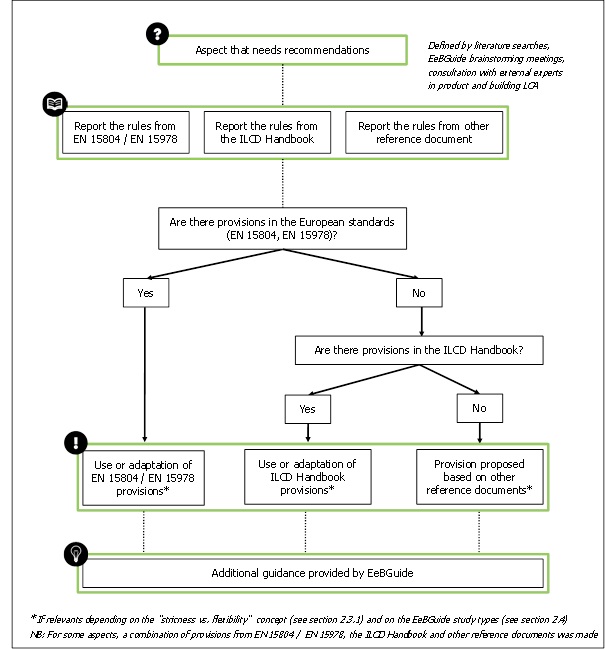
As mentioned above, the EeBGuide tries to combine provisions and guidance from the EN 15804 and EN 15978 standards and the ILCD Handbook (see Figure 5). If cases of contradictory approaches appear in the reference sources, then the EeBGuide always tries to state a provision or guidance transparently for both the standard and the ILCD Handbook. As far as possible, the EeBGuide provisions follow the European standards [EN 15804] and [EN 15978] closely. If the standard does not mention a certain aspect, or if it is not very clear on that aspect, provisions and guidance from the ILCD Handbook are provided. Where no existing guidance is available, other provisions are proposed by the EeBGuide.

Figure 5: Procedure for adaptation from the CEN TC 350 standards and ILCD Handbook

Guidance can include links to further interesting or important information, or to examples, or present an interpretation of the standard or the ILCD Handbook. This interpretation is not meant to be a provision, but rather a means to share LCA experiences from LCA practitioners and experts.


2     Methodological approach of the EeBGuide.

5.1 Overview

This chapter addresses aspects that are related not to a single building life cycle stage but to several, and therefore represent common LCA questions. Also, these aspects typically relate both to buildings and to products. They provide provisions, rules and guidance for the goal and scope definition, the inventory analysis, the impact assessment and the interpretation steps according to ISO 14040-44. The following list describes the aspects addressed, which cover issues that typically need to be addressed when conducting an LCA study on a building product or a building.

Back to EeBGuide Guidance Document Part B: BUILDINGS