10 Discussions and perspectives

In this chapter some of the findings of the project are discussed, connections to other research projects are made, and possible future developments of the EeBGuide guidance document are addressed.

The original aim of the EeBGuide project was not to develop new provisions or even standards for LCA, but to summarize existing provisions from the European standards and the ILCD Handbook, and give guidance on important LCA topics. This guidance is based on the latest LCA practitioners’ experience, and on findings from the EeBGuide project partners’ research and development activities, as well as from other European research projects. LCA practitioners now have a document that gives provisions for and guidance on the critical and most relevant aspects of conducting an LCA study for buildings and building products.

The EeBGuide project’s methodological approach was to combine both the CEN TC 350 and ILCD provisions. In this context, the guidance document remains as transparent as possible by linking to original rules from these reference documents and the chosen provision and guidance. The reference documents sometimes conflict. As far as possible, provisions from CEN TC 350 were applied, but if no provisions were given there, then the ILCD Handbook provisions were also considered (e.g. for consequential modelling). In some cases, both provisions (from CEN and ILCD) were considered, as they provide complementary rules that fulfil different goals and scopes for product or building LCAs (e.g. for the choice of environmental indicators). However, more work will be needed to analyse in greater detail the implications of ILCD provisions when applied to product and building LCA studies. The need for growing consistency between standards and ILCD documentation, however, was obvious throughout the project.

The EeBGuide guidance document is a new contribution to an existing set of documents providing operational guidance for building LCA studies. For example, two previous European research projects (LoRe-LCA and ENSLIC Building) can be also considered relevant sources of information for the LCA practitioner. They provide complementary guidance for some of the aspects covered in the EeBGuide. As far as possible, existing guidance from these projects was reported in the EeBGuide, e.g. by referring to online documentation or deliverables. However, not all of the aspects addressed in the EeBGuide guidance document were covered in these two previous European projects.

Indeed, the main innovation of the EeBGuide guidance document, compared with these previous projects, is to bring together  in a structured document some of the latest findings from the LCA and construction community. More than 150 aspects have been identified to be taken into account for a product or a building LCA. They are structured according to the LCA framework: i.e. goal and scope definition, inventory analysis, impact assessment, interpretation and reporting. This allows any LCA practitioner not necessarily aware of the specific wording of the CEN TC 350 standards to easily go through the document and identify the appropriate rules to follow. At the same time, the aspects are classified according to the life cycle stages of the EN 15804 and EN 15978 standards (Modules A, B, C and D). The provisions and guidance are broken down according to the study types (screening, simplified and complete LCA) so as to allow the practitioner to easily identify the main recommendations according to the stage of a project. The EeBGuide guidance document makes a distinction between stand-alone LCA and comparative assertions. This difference is very important, as comparative studies require more consistency to ensure that the results are not biased. The EeBGuide guidance document also distinguishes provisions for new buildings from those for existing buildings, as the LCA studies will not refer to the same goal and system boundaries. Reporting and review templates for case studies are also part of the guidance.

It is notable that some outcomes of the discussions of the EeBGuide project – within the consortium, with LCA experts, within the public consultation and with the review panel – proved relevant for the value of this document. Among the most important contributions to the general discussion of LCA in construction, the separation of operational guidance between product LCAs and building LCAs – and at the same time the assurance of consistency of these provisions – is one of the most relevant findings. In addition, the formulation of the concept of different study types – screening LCA, simplified LCA and complete LCA – in line with rules on when to apply which study type for what purpose, and how and what to include and exclude, reflects a common need of practitioners. The value of these concepts is given with the fact that the LCA community may now refer to uniform rules on how to conduct studies of the different types.

To summarise, the EeBGuide guidance document takes into account not only the latest findings of recent European projects and research and development works conducted at, for example CSTB (Environment department), Fraunhofer (IBP-GaBi department), PE International, the UNESCO Chair in Life Cycle and Climate Change at the University of Barcelona, and BRE Global, but also current provisions from the standards of CEN TC 350 and the ILCD Handbook. Finally, the EeBGuide guidance document is one of the first contributions at the European level towards a merging of relevant provisions from ILCD and CEN TC 350 in a consistent way. The EeBGuide partners believe that such a consistent guidance document provides a highly operational yet scientifically sound document for the building sector. The EeBGuide guidance document can now be used by the primary audience (LCA practitioners within E2B EI projects) and the secondary audience (building LCA tool developers and certification schemes).

As it is the first comprehensive contribution with the goal of merging diverging reference documents for different study types, the partners remain aware that many research topics still have to be conducted in the near future to support and more precisely specify the different definitions and guidance given as a first step in this guide. If there are any follow-on research projects in this direction, the results could be included in a new version of the EeBGuide. Also if there are new developments or outcomes from the standardization work or the ECO platform, these results will have to be incorporated in the guidance document as well. The EeBGuide guidance document has also identified issues that are not completely resolved when applying the CEN TC 350 standards. It may be a useful document for the standardization committee when revising the EN 15804/EN 15978 standards.

Further outcomes of more operational projects, such as the SBA Common Metrics project, have to be considered as very important contributions next to the EeBGuide guidance document to ensure comparability within different LCA studies. Future research projects should also focus on a common European reference building as a baseline scenario. Here, the most important parameters should be investigated (e.g. reference study periods, main EoL scenarios for materials, etc.) in order to define a European baseline scenario, providing average European values for its parameters, which will facilitate comparisons between research projects, and support the evolution of building labelling schemes.

List of abbreviations

ADP abiotic depletion potential
ADPE abiotic resource depletion potential for elements
ADPF abiotic resource depletion potential of fossil fuels
AP acidification potential
BLBSB benefits and loads beyond the system boundary
BREEAM BRE Environmental Assessment Method
BWR basic work requirements
CML Centrum voor Milieukunde, Leiden (NL)
CPD Construction Products Directive
CPR Construction Products Regulation
CRU components for reuse
DGNB Deutsche Gesellschaft für Nachhaltiges Bauen (German Sustainable Building Council)
DSLT dynamic surface leaching test
E2B EI Energy-Efficient Building European Initiative
ECO European Construction Product Organization
EE exported energy per energy carrier
EMAS Eco-Management and Audit System Regulations
EoL end of life
EP eutrophication potential
EPBD Energy Performance of Buildings Directive
EPD Environmental Product Declaration
ESL estimated service life
ETAP Environmental Technologies Action Plan
FW use of net fresh water
GPP Green Public Procurement
GWP global warming potential (climate change)
HQE Haute Qualité Environmentale (French association and certification mark)
HWD hazardous waste disposed
IBU Institut Bauen und Umwelt e.V. (German EPD programme)
ID Interpretative Documents
ILCD International Reference Life Cycle Data System
IPP Integrated Public Policy
LCA life cycle assessment
LCC life cycle costing
LCI life cycle inventory (analysis)
LCIA life cycle impact assessment
LHV low heating value
MER materials for energy recovery
MFR materials for recycling
NHWD non-hazardous waste disposed
NPP net primary production
NRSF use of non-renewable secondary fuels
ODP ozone layer depletion potential
PCM phase change material
PCR Product Category Rules
PENRE use of non-renewable primary energy (excluding non-renewable primary energy resources used as raw materials)
PENRM non-renewable primary energy resources used as raw materials
PENRT total use of non-renewable primary energy resources
PERE use of renewable primary energy (excluding renewable primary energy resources used as raw materials)
PERM use of renewable primary energy resources used as raw materials
PERT total use of renewable primary energy resources
POCP photochemical ozone creation potential
ReqSL required service life
RSF use of renewable secondary fuels
RSL reference service life
RSP reference study period
RWD radioactive waste disposed
SBA Sustainable Building Alliance
SIP Sustainable Industrial Policy
SLP service life planning
SM use of secondary material

Literature

[ADEME 2003] Déconstruire les bâtiments (in French), Collection: Connaître pour Agir: Guides et cahiers techniques, ADEME, 160p, 2003.
[AgBB 2010] AgBB. Vorgehensweise bei der gesundheitlichen Bewertung der Emissionen von flüchtigen organischen Verbindungen (VOC und SVOC) aus Bauprodukten, 2010. Available on http://www.umweltbundesamt.de/produkte/bauprodukte/dokumente/AgBB-Bewertungsschema_2010.pdf
[Baitz 2002] Baitz, M. ‘Die Bedeutung der funktionsbasierten Charakterisierung von Flächen-Inanspruchnahmen in industriellen Prozesskettenanalysen’. PhD Thesis (in German), University of Stuttgart, 2002.
[Bare 2003] Bare, J.C., Norris, G.A., Pennington, D.W., McKone, T.E. ‘TRACI, The Tool for the Reduction and Assessment of Chemical and Other Environmental Impacts’, Journal of Industrial Ecology, Volume 6, 2003.
[Bath 2011] Embodied Carbon: The Inventory of Carbon and Energy, University of Bath. Printed version (as of January 2011) from BSRIA BG10/2011 ISBN 978 0 86022 703 8 BS,
[Beck 2010] Beck, T. et al (2010): LANCA. Land use indicator value calculation in life cycle assessment. Stuttgart: Fraunhofer-Verl. ISBN: 978-3-8396-0170-9;
[Berger 2010] Berger, M.; Finkbeiner, M.:Water Footprinting: How to Address Water Use in Life Cycle Assessment?; Sustainability 2010 2(4); ISSN 2071-1050
[Borg 2001] Borg, M., Paulsen, J., Trinius, W.: Proposal of a method for allocation in building-related environmental LCA based on economic parameters. International Journal of Life Cycle Assessment 6 (2001) 4, pp. 219–230. Online: doi: 10.1007/BF02979378.
[Bos 2008] Bos, U., and Wittstock, B. ‘Land use methodology. Report to summarize the current situation of the methodology to quantify the environmental effects of Land Use’, Report, Lehrstuhl für Bauphysics, University of Stuttgart, 2007.
[BRE 2011] BRE Group: BREEAM – BRE Environmental Assessment Method. Webseite. Watford: BRE Global Ltd 2011. Online:http://www.breeam.org/page.jsp?id=176, last checked: 7.3.2011.
[CALCAS 2009] CALCAS Project, 2009, Deliverable D17: Final Report: options for deepening and broadening LCA. Available online: http://www.estis.net/builder/includes/page.asp?site=calcas&page_id=8215FF89-5114-4748-BE6C-1F0F1E69DAF5
[CEC 1988] Council of the European Communities 1988, “Council directive of 21 December 1988 on the approximation of laws, regulations and administrative provisions of the Member States relating to building products, 89/106/EEC
[CEN 2005] CEN: CEN/TC 350 Sustainability of construction work – Executive Summary. Brussels: CEN – European Committee for Standardization 2005. Online: http://www.cen.eu/cen/Sectors/TechnicalCommitteesWorkshops/CENTechnicalCommittees/Pages/PdfDisplay.aspx, last checked: 06.11.2011.
[CEN 2010a] CEN – Comité Européen de Normalisation. TR 15941. Sustainability of construction works. Environmental product declarations. Methodology for selection and use of generic data, 2010, 20p.CEN – Comité Européen de Normalisation. CEN/TC 351/WG 1/TS-2. Generic horizontal dynamic surface leaching test (DSLT) for determination of surface dependent release of substances from monolithic or plate-like or sheet-like building products, 2010a, 31p.
[CEN 2010b] CEN – Comité Européen de Normalisation. CEN/TC 351/WG 1/TS-3. Generic horizontal up-flow percolation test for determination of the release of substances from granular building products, 2010b, 37p.
[CEN 2010c] CEN – Comité Européen de Normalisation. CEN/TC 351/WG2. Determination of emission of dangerous substances from building products into indoor air, 2010c.
[Chen 2010] Chen, C., Habert, G., Bouzidi, Y., Jullien, A., Ventura, A: ‘LCA allocation procedure used as an incitative method for waste recycling: An application to mineral additions in concrete’, Resources, Conservation and Recycling, Volume 54, Issue 12, October 2010, Pages 1231–1240
[Cole 1996] R J Cole and P C Kernon, Life Cycle Energy use in Office Buildings, Building and Environment 31 (4) 1996
[CPR 2011] European Union: Regulation (EU) No 305/2011 of the European Parliament and the Council of 9 March 2011 laying down harmonised conditions for the marketing of building products and repealing Council Directive 89/106/EEC. (CPR) (Official Journal of the European Union) Brussels: 2011.
[De Schryver 2009] De Schryver and Goedkoop. Land Use. Chapter 10 in: Goedkoop, M., Heijungs, R., Huijbregts, M.A.J., De Schryver, A., Struijs, J., Van Zelm, R. ‘ReCiPe 2008 A life cycle impact assessment method which comprises harmonised category indicators at the midpoint and the endpoint level. Report I: Characterisation’, first edition, 2009, available online: http://www.lcia-recipe.net/
[Derwent 1998] Derwent, R.G., Jenkin, M.E., Saunders, S.M., Pilling, M.J: ‘Photochemical ozone creation potentials for organic compounds in Northwest Europe calculated with a master chemical mechanism’, Atmospheric Environment, Volume 32, 1998.
[DIBt 2009] DIBt. Grundsätze zur Bewertung der Auswirkungen von Bauprodukten auf Boden und Grundwasser – Teil 1, Mai 2009. DIBt Mitteilungen 40 (2009) 4, S. 116-134. and Teil II – Juli 2009, Teil III – Mai 2009. DIBt Mitteilungen 40 (2009) 5, S. 169–179
[DIN V 18599], DIN V 18599, Energetische Bewertung von Gebäuden – Berechnung des Nutz-, End- und Primärenergiebedarfs für Heizung, Kühlung, Lüftung, Trinkwarmwasser und Beleuchtung, 2009
[Earles 2011] Earles, J-M., Halog, A ‘Consequential life cycle assessment: a review’. International Journal of Life Cycle Assessment, Volume 16, 2011.
[EC 2005a] European Commission. Harmonization of indoor material emissions labelling systems in the EU, 2005. Available on: http://www.inive.org/medias/ECA/ECA_Report24.pdf
[EC 2005b] European Commission. Enterprise and Industry Directorate-General. Chemicals and Construction. M /366 EN – Horizontal Complement to the Mandates to CEN/CENELEC concerning the execution of standardization work for the development of horizontal standardised assessment methods for harmonised approaches relating to dangerous substances under the Construction Products Directive (CPD). Emission to indoor air, soil, surface water and ground water, Brussel, 24p, 2005.
[EC 2011] European Commission. Enterprise and Industry Directorate-General. Chemicals and Construction. Construction. DS 041/051 rev.10. Indicative list of regulated dangerous substances possibly associated with construction products under the CPD, 2011, 29p
[Elliot 2008] Elliot, L., Breslau, B., Wolody, D. Jones Lang LaSalle & CoreNet Global (Ed.): Global Trends in Sustainable Real Estate: An Occupier’s Perspective. London, Boston, Sydney 2008.
[EN 15643-1] EN 15643-1: Sustainability of construction works – Assessment of buildings – Part 1: General framework. CEN – European Committee for Standardization. Brussels: CEN-CENELEC 2011.
[EN 15643-2] EN 15643-2: Sustainability of construction works – Assessment of buildings – Part 2: Framework for the assessment of environmental performance. CEN – European Committee for Standardization. Brussels: CEN-CENELEC 2011.
[EN 15804] EN 15804: Sustainability of construction works – Environmental product declarations – Core rules for the product category of building products. CEN – European Committee for Standardization. Brussels: CEN – CENELEC 2011.
[EN 15978] EN 15978: Sustainability of construction works – Sustainability assessment of buildings – calculation method. CEN – European Committee for Standardization. Brussels: CEN – CENELEC 2010.
[ENSLIC 2011] ENSLIC-Building: Energy Saving through Promotion of Life Cycle Assessment in Buildings, European project (FP7), 2011, deliverables available online: http://circe.cps.unizar.es/enslic/texto/wor.htm
[Foster 2007] Forster, P., Ramaswamy, V.: Chapter 2. Changes in Atmospheric Constituents and in Radiative Forcing. In: Solomon, S., Quin, D., Manning, M., et al. (Ed.): Climate change 2007. The physical science basis ; contribution of Working Group I to the Fourth Assessment Report of the Intergovernmental Panel on Climate Change. New York: UNEP 2007, pp. 129–234.
[Franklin 2011] Economic Bulletin, Franklin and Andrews March 2010;Embodied Carbon in Construction: What we know about Building Services, John Connaughton (Davis Langdon). CIBSE Technical Symposium, Leicester September 2011;
[Frischknecht 2000] Frischknecht, R., Braunschweig, A., Hofstetter, P., Suter, P. Human health damages due to ionizing radiation in life cycle impact assessment. Environ. Impact Assess. Rev. (2000) 20: 159–189.
[Frischknecht 2007] Frischknecht, R., Althaus, H-J., Bauer, C., Doka, G., Heck, T., Jungbluth, N., Kellenberger, D., et Nemecek, T: ‘The Environmental Relevance of Capital goods in Life Cycle Assessments of Products and Services’. The International Journal of Life Cycle Assessment, Volume 11, 2007.
[Frischknecht 2008] Frischknecht et al., Swiss Ecoscarcity, 2008
[Frischknecht 2010] Frischknecht, R., Stucki, M ‘Scope-dependent modelling of electricity supply in life cycle assessments’. International Journal of Life Cycle Assessment, Volume 15, 2010.
[Gomès 2012] Gomès, F., Brière, R., Habert, G., Feraille, A., Lasvaux, S., Tessier, C: ‘Environemntal evaluation of reinforced steel sold on the French market’, Proceedings of the International Symposium on Life Cycle Assessment and Construction – Civil Engineering and Buildings, 10–12 July 2012, Nantes, France, 8p.
[Guidance Paper F 2004] European Union: Legislation, ‘Guidance Paper F – Durability and the Building products Directive’, Revision December 2004
[Guinée 2002] Guinée, J. B., Gorrée, M., Heijungs, R. et al: Handbook on Life Cycle Assessment Operational Guide to the ISO Standards. Dordrecht u.a. Kluwer Academic Publishers; Kluwer Acad. Publ. (Series Eco-Efficiency in Industry and Science, Volume 7, 2002. ISBN: 1-4020-0557-1.
[Habert 2009] Habert, G., Bouzidi, Y., Chen, C., Jullien, A. ‘Development of a depletion indicator for natural resources used in concrete’, Resources, Conservation and recycling, Volume 54, 2009.
[Habert 2012] Habert, G., Roussel, N. ‘An allocation method based on relative profit between industrial sectors’, Proceedings of the International Symposium on Life Cycle Assessment and Construction – Civil Engineering and Buildings, 10–12 July 2012, Nantes, France, 8p.
[Herfray 2011] Herfray, G. ‘Contribution to the evaluation of environmental impacts of urban settlements’, PhD Thesis (in French), MINES ParisTech, available online: http://pastel.archives-ouvertes.fr/docs/00/65/82/ 20/PDF/Herfray.pdf)
[Herfray 2012] Herfray, G., Peuportier, B: ‘Evaluation of electricity related impacts using a dynamic LCA model’, Proceedings of the International Symposium on Life Cycle Assessment and Construction – Civil Engineering and Buildings, 10–12 July 2012, Nantes, France, 9p.
[Hodkova 2012] Hodkova, J., Lasvaux, S: ‘Guidelines for the use of existing Life Cycle Assessment data of building materials as generic data for a national context’, Proceedings of the International Symposium on Life Cycle Assessment and Construction – Civil Engineering and Buildings, 10–12 July 2012, Nantes, France, 9p.
[Hodo 2010] Hondo, H. (Ed.): EcoBalance 2010. The 9th International Conference on EcoBalance. Towards & Beyond 2020. Manuscripts. November 9–12, 2010. Tokio: ILCAJ 2010.
[Hofstetter 1998] Hofstetter, P. ‘Perspectives in Life Cycle Impact Assessment. A Structure Approach to Combine Models of the Technosphere, Ecosphere and Valuesphere’. Kluwer Academic Publishers, Dordrecht, The Netherlands, 484 pp, 1998.
[Huijbregts 2000] Huijbregts, M.A.J., Thissen, U., Guinée, J.B., Jager, T., Van de Meent, D., Ragas, A.M.J., Wegener Sleeswijk, A., Reijnders, L. ‘Priority assessment of toxic substances in life cycle assessment, I: Calculation of toxicity potentials for 181 substances with the nested multi-media fate, exposure and effects model USES-LCA’, Chemosphere, Volume 41, 2000.
[Huijbregts 2001] Huijbregts, M., Norris, G., Bretz, R., Ciroth, A., Maurice, B., von Bahr, B., Weidema, B., et de Beaufort, A. ‘Framework for modelling data uncertainty in life cycle inventories’, The International Journal of Life Cycle Assessment, Volume 6, 2001.
[Huijbregts 2005] Huijbregts, M.A.J., Rombouts, L.J.A., Ragas A.M.J., Van de Meent, D. (2005). Human-toxicological effect and damage factors of carcinogenic and noncarcinogenic chemicals for life cycle impact assessment. Integrated Environ. Assess. Manag. 1: 181-244.
[Huijbregts 2009] Huijbregts, M.A.J., Van Zelm, R. ‘Ecotoxicity and human toxicity’. Chapter 7 in: Goedkoop, M., Heijungs, R., Huijbregts, M.A.J., Struijs, J., De Schryver, A., Van Zelm, R. ‘ReCiPe 2008 A life cycle impact assessment method which comprises harmonised category indicators at the midpoint and the endpoint level. Report I: Characterization factors’, first edition, 2009.
[ILCD 2010a] European Commission – Joint Research Centre – Institute for Environment and Sustainability (Ed.): ILCD Handbook. General guide for life cycle assessment: detailed guidance. First edition. Luxembourg: Publications Office of the European Union 2010. ISBN: 978-92-79-19092-6.
[ILCD 2010b] European Commission – Joint Research Centre – Institute for Environment and Sustainability (Ed.): ILCD Handbook. Analysis of existing Environmental Impact Assessment methodologies for use in Life Cycle Assessment. First edition. Luxembourg: Publications Office of the European Union 2010.
[ILCD 2010c] European Commission – Joint Research Centre – Institute for Environment and Sustainability (Ed.): ILCD Handbook. Framework and requirements for Life Cycle Impact Assessment models and indicators. First edition. Luxembourg: Publications Office of the European Union 2010.
[ILCD 2011a] European Commission – Joint Research Centre – Institute for Environment and Sustainability (Ed.): ILCD Handbook. Recommendations for Life Cycle Impact Assessment in the European context – based on existing environmental impact assessment models and factors. First edition. Luxembourg: Publications Office of the European Union 2011. ISBN: 978-92-79-17451-3.
[ILCD 2011b] European Commission – Joint Research Centre – Institute for Environment and Sustainability (Ed.): ILCD Handbook. Characterization Factors of the ILCD, Recommended Life Cycle Impact Assessment methods, database and supporting information. First edition. Luxembourg: Publications Office of the European Union 2012. ISBN: 978-92-79-22727-1.
[INSEE, 2006] Institut national de la statistique et des études économiques (INSEE) (2006). Les logements en 2006. Available on: http://www.insee.fr/fr/themes/document.asp?ref_id=ip1202
[ISO 14025] ISO 14025: Environmental labels and declarations – Type III environmental declarations – Principles and procedures. ISO – International Organization for Standardization. Geneva: ISO 2006.
[ISO 14040] ISO 14040 Environmental management – Life cycle assessment – Principles and framework;.
[ISO 14044] ISO 14044 Environmental management – Life cycle assessment – Requirements and guidelines
[ISO 15686] ISO 15686 series: Buildings and construction assets – Service life planning Part 1 to 10. ISO – International Organization for Standardization. Geneva: ISO 2011.
[ISO 16000-11] ISO 16000-11, Indoor air – Part 11: Determination of volatile organic compounds from building products and furnishing – Sampling, storage of samples and preparation of test specimens;
[ISO 16000-3] ISO 16000-3, Indoor air – Part 3: Determination of formaldehyde and other carbonyl compounds – Active sampling method
[ISO 16000-6] ISO 16000-6, Indoor air – Part 6: Determination of volatile organic compounds in indoor and test chamber air by active sampling on Tenax TA sorbent, thermal desorption and gas chromatography using MS or MS/FID
[ISO 16000-9] ISO 16000-9, Indoor air – Part 9: Determination of volatile organic compounds from building products and furnishing – Emission test chamber method
[ISO 16017-1] EN ISO 16017-1: Indoor, ambient and workplace air – Sampling and analysis of volatile organic compounds by sorbent tube/thermal desorption/capillary gas chromatography – Part 1: Pumped sampling;
[Jolliet 2003] Jolliet, O., Margni, M., Charles, R., Humbert, S., Payet, J., Rebitzer, G., Rosenbaum, R. ‘IMPACT 2002+: A New Life Cycle Impact Assessment Methodology’, International Journal of Life Cycle Assessment, Volume 8, 2003.
[JORF 2011] JORF. Décret n° 2011-321 du 23 mars 2011 relatif à l’étiquetage des produits de construction ou de revêtement de mur ou de sol et des peintures et vernis sur leurs émissions de polluants volatils, 2011, 3p.
[Kellenberger 2009] Kellenberger, D. & Althaus, H.-J. 2009. Relevance of simplifications in LCA of building components. Building and Environment, 44, 818–825
[Kemna 2005] Kemna, R., Van Elburg, M., Li W., Van Holsteijn, R. ‘MEEUP – Methodology Report’, European Commission, Brussels, 2005.
[Koellner 2012] Koellner et al, Principles of inventory of land use on a global scale, 2012, The International Journal of Life Cycle Assessment (21 March 2012), pp. 1–13, doi:10.1007/s11367-012-0392-0
[Lasvaux 2010] Lasvaux, S. ‘Study of a simplified model for the Life Cycle Assessment of buildings’, PhD thesis (in French), MINES ParisTech, available online: http://pastel.archives-ouvertes.fr/docs/00/71/20/43/PDF /19919_LASVAUX_2010.pdf)
[Lasvaux 2011] Lasvaux, S., Chevalier, J., Peuportier, B. ‘A data analysis tool to compare two LCA databases of construction materials used in building LCA applications for the French context’, Proceedings of the Life Cycle Assessment XI Conference, 4–6 October 2011, Chicago, USA, 11p.
[Lasvaux 2012] Lasvaux, S., Schiopu, N., Peuportier, B., Chevalier, J., ‘Relevance of a French simplified Life Cycle Inventory database using building products industry data’, Proceedings of the International Symposium on Life Cycle Assessment and Construction – Civil Engineering and Buildings, 10–12 July 2012, Nantes, France, 9p.
[Lebert 2012] Lebert, A., Lasvaux, S., Chevalier, J., Hans, J., ‘Environmental Performances of Buildings: identification of reference values through a statistical analysis’, Proceedings of the International Symposium on Life Cycle Assessment and Construction – Civil Engineering and Buildings, 10–12 July 2012, Nantes, France, 9p.
[Lemaitre 2009] Lemaitre, C., DGNB (Ed.): Nachhaltiges Bauen. DGNB Handbuch Neubau Büro- und Verwaltungsgebäude Version 2009. Stuttgart: DGNB 2009. ISBN: 978-3-942132-00-8.
[Leroy 2012] Leroy, C., Thomas, J-S., Avery, N., Bollen, J., Tikana, L. ‘Tackling recycling aspects in EN 15804’, Proceedings of the International Symposium on Life Cycle Assessment and Construction – Civil Engineering and Buildings, 10–12 July 2012, Nantes, France, 8p.
[LoRe-LCA 2011] LoRe-LCA: Low Resource consumption buildings and constructions by use of LCA in design and decision-making, European project (FP7), 2011, deliverables available online: http://www.sintef.no/ Projectweb/LoRe-LCA/Training/
[Lupsea 2012] Lupsea, M., Schiopu, N., Tiruta-Barna, L. Leaching of building products during their use stage: proposal for a reliable Life Cycle Inventory (LCI) of the released substances in water and soil. Proceeding of the international symposium on Life Cycle Assessment and Construction – Civil Engineering and Buildings, 10–12 July 2012, Nantes, France, 10p.
[Milà i Canals 2007] Milà i Canals, L., Bauer, C., Depestele, J., Dubreuil, A., Freiermuth Knuchel, R., Gaillard, G., Michelsen, O., Müller-Wenk, R., Rydgren B. ‘Key elements in a framework for land use impact assessment within LCA’, The International Journal of Life Cycle Assessment, volume 12, 2007.
[Nemry 2008] Nemry, F., Uihlein, A., Makishi Colodel, C., et al.: Environmental Improvement Potentials of Residential Buildings. (IMPRO-Building). (JRC Scientific and Technical Reports). Luxembourg: Office for Official Publications of the European Communities 2008. ISBN: 978-92-79-09767-6.
[Oers 2002] Oers, L. van, A. de Koning, J.B. Guinée & G. Huppes, ‘Abiotic resource depletion in LCA – Improving characterisation factors for abiotic resource depletion as recommended in the new Dutch LCA Handbook’, DWW report, Delft; available on: http://www.cml.leiden.edu/research/industrialecology/researchprojects/finished/abiotic-depletion-lcia.html
[Paulsen 2003] Paulsen, J. H., Borg, M.: A building sector related procedure to assess the relevance of the usage phase. The International Journal of Life Cycle Assessment 8 (2003) 3, pp. 142–150. Online: doi: 10.1007/BF02978459.
[Peuportier 2008] Peuportier, B. ‘Eco-conception des bâtiments et des quartiers’. Presse de l’Ecole des Mines de Paris, 2008. ISBN: 978-2-35671-001-7
[Pfister 2009] Pfister, S.; Koehler, A.M; Hellweg, Assessing the Environmental Impacts of Freshwater Consumption in LCA; Environ. Sci. Technol. 2009, 43, 4098–41042008
[Potting 2005] Potting, J. and Hauschild, M. ‘Background for spatial differentiation in life cycle impact assessment – the EDIP2003 methodology’, Environmental project no. 996, Danish Environmental Protection Agency, Copenhagen, 2005.
[Rosenbaum 2008] Rosenbaum, R.K., Bachmann, T.M., Gold, L.S., Huijbregts, M.A.J., Jolliet, O., Juraske, R., Köhler, A., Larsen, H.F., MacLeod, M., Margni, M., McKone, T.E., Payet, J., Schuhmacher, M., van de Meent, D., Hauschild, M.Z. ‘USEtox – The UNEP-SETAC toxicity model: recommended characterisation factors for human toxicity and freshwater ecotoxicity in Life Cycle Impact Assessment’ International Journal of Life Cycle Assessment, Volume 13, 2008.
[Solomon 2007] Solomon, S., Quin, D., Manning, M., et al. (Ed.): Climate change 2007. The physical science basis ; contribution of Working Group I to the Fourth Assessment Report of the Intergovernmental Panel on Climate Change. New York: UNEP 2007. ISBN: 978 0 521 88009 1.
[Van Caneghem 2010] Van Caneghem, J., Block, C., et Vandecasteele, C. ‘Assessment of the impact on human health of industrial emissions to air: Does the result depend on the applied method?’, Journal of Hazardous Materials, Volume 184, 2010.
[Van Zelm 2008] Van Zelm, R., Huijbregts, M.A.J., Den Hollander, H.A., Van Jaarsveld, H.A., Sauter, F.J., Struijs, J., Van Wijnen, H.J., Van de Meent, D. (2008). European characterization factors for human health damage of PM10 and ozone in life cycle impact assessment. Atmospheric Environment 42, 441–453.
[VROM 2007] VROM – Dutch Ministry of Spatial Planning Housing and the Environment. Soil Quality Decree (Netherlands), Decree of 22 November 2007 containing rules with respect to the quality of soil (Soil Quality Decree). Bulletin of Acts, Orders and Decrees of the State of the Netherlands, 34p, 2007.
[Waste directive 2008] European Union. Directive 2008/98/EC of the European parliament and of the council on waste and repealing certain directives. Off J Eur Union 2008;L312:3–30.
[WCED 1987] World Commission on Environment and Development: Our common future. Oxford: Oxford University Press 1987. ISBN: 019282080X.
[Weidema 1996] Weidema, B., et Wesnes, M. ‘Data quality management for life cycle inventories – an example of using data quality indicators’. Journal of Cleaner Production, Volume 4, 1996.
[Wittstock 2010] Wittstock, B., Fischer, M., Kreißig, J., et al.: The Role of LCA in the German Sustainable Building labelling. In: Hondo, H. (Ed.): EcoBalance 2010. The 9th International Conference on EcoBalance. Towards & Beyond 2020. Manuscripts. November 9–12, 2010. Tokio: ILCAJ 2010, pp. 81–82.
[Wittstock 2011] Wittstock, B., Braune, A., Fischer, M., et al.: LCA in Building labelling: Experiences from Germany. In: Finnish Association of Civil Engineers RIL, VTT Technical Research Centre of Finland (Ed.): SB 11 Helsinki. World Sustainable Building Conference. Oct. 18–21, 2011. Proceedings, vol. 1. Helsinki 2011, pp. 134–135.
[Zamagni 2012] Zamagni, A., Guinée, J., Heijungs, R., Masoni, P., Raggi, A ‘Light and shadows in consequential LCA’. International Journal of Life Cycle Assessment, Volume 17, 2012.

Annex A: Default Values.

When conducting an LCA study, the practitioner is constantly confronted with figures: some are needed to specify a modelling parameter; others are needed as cross-references, or benchmarks for comparison purposes. Such numbers always depend on the context of a study, and are generally not globally valid, which is why this guidance does not specify the use of predefined default values.

For numerous studies, however, average or default values may be helpful, and have the potential to significantly reduce the effort for data collection, especially if the relevant figures are required, yet are not critical for the study outcome. Also, to gain confidence in one’s study, the practitioner may use such values for cross-reference. For such purposes, a non-comprehensive collection of various default values is provided in this Annex. This collection of values does not claim to be ultimately right, and the practitioner has to decide by himself or herself whether the given values are applicable to the study’s context, and whether utilizing these values will be beneficial for the study.

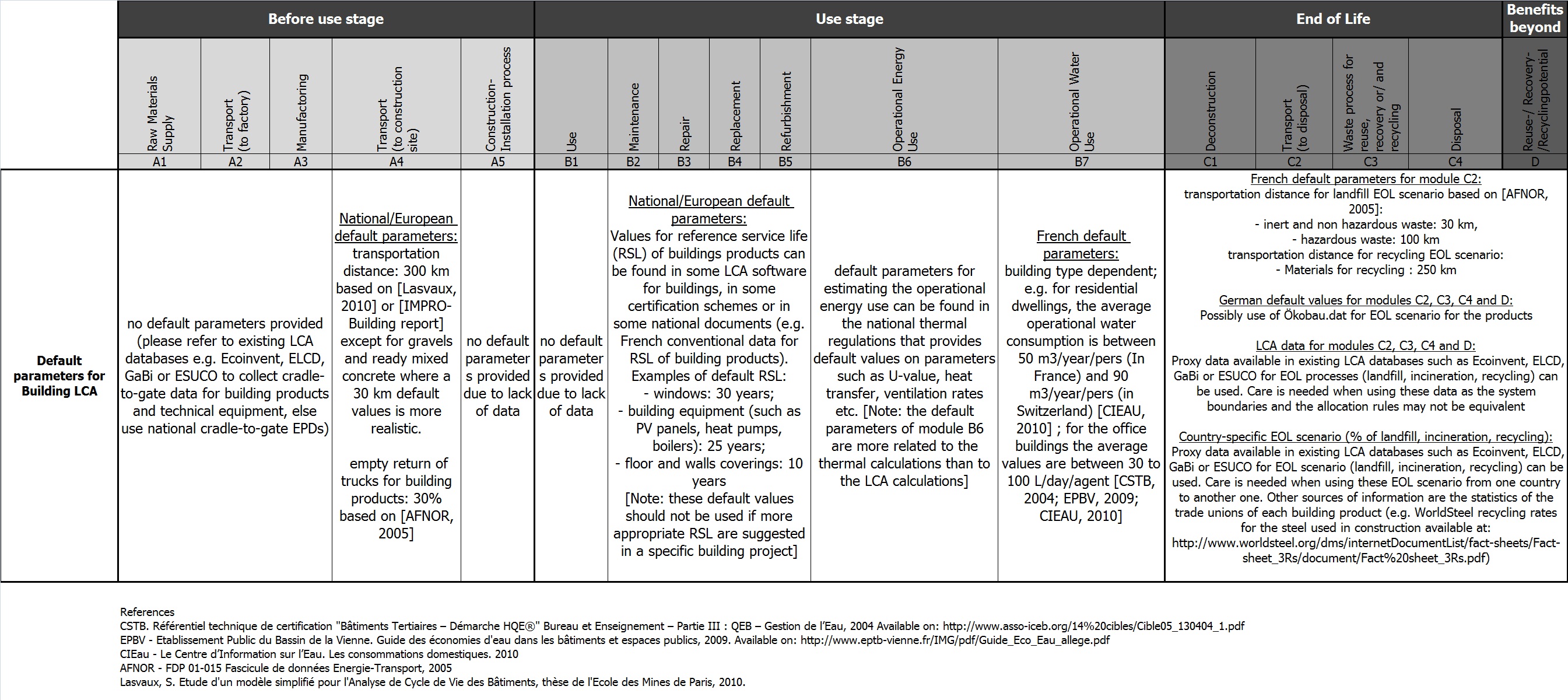
Default Parameters for Building LCA

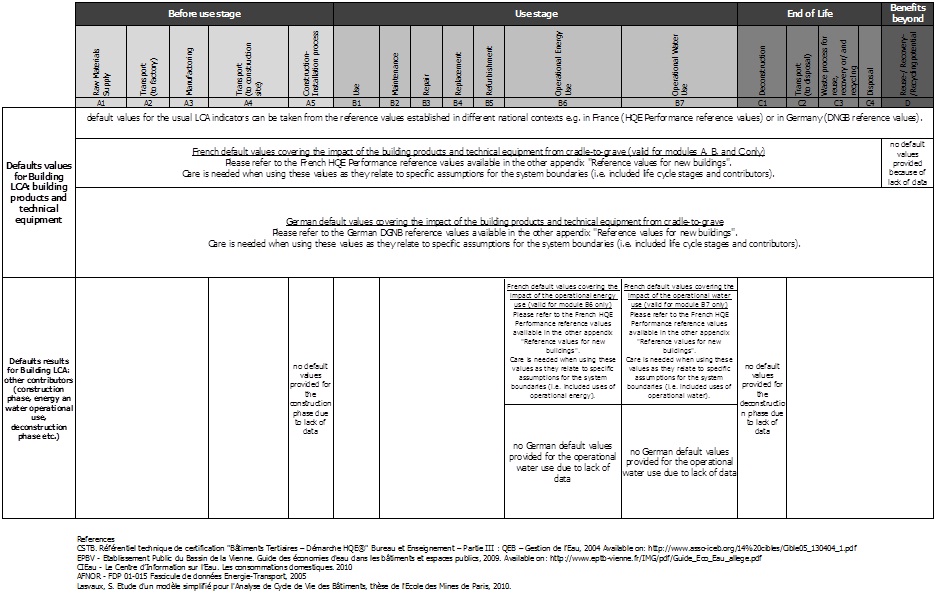
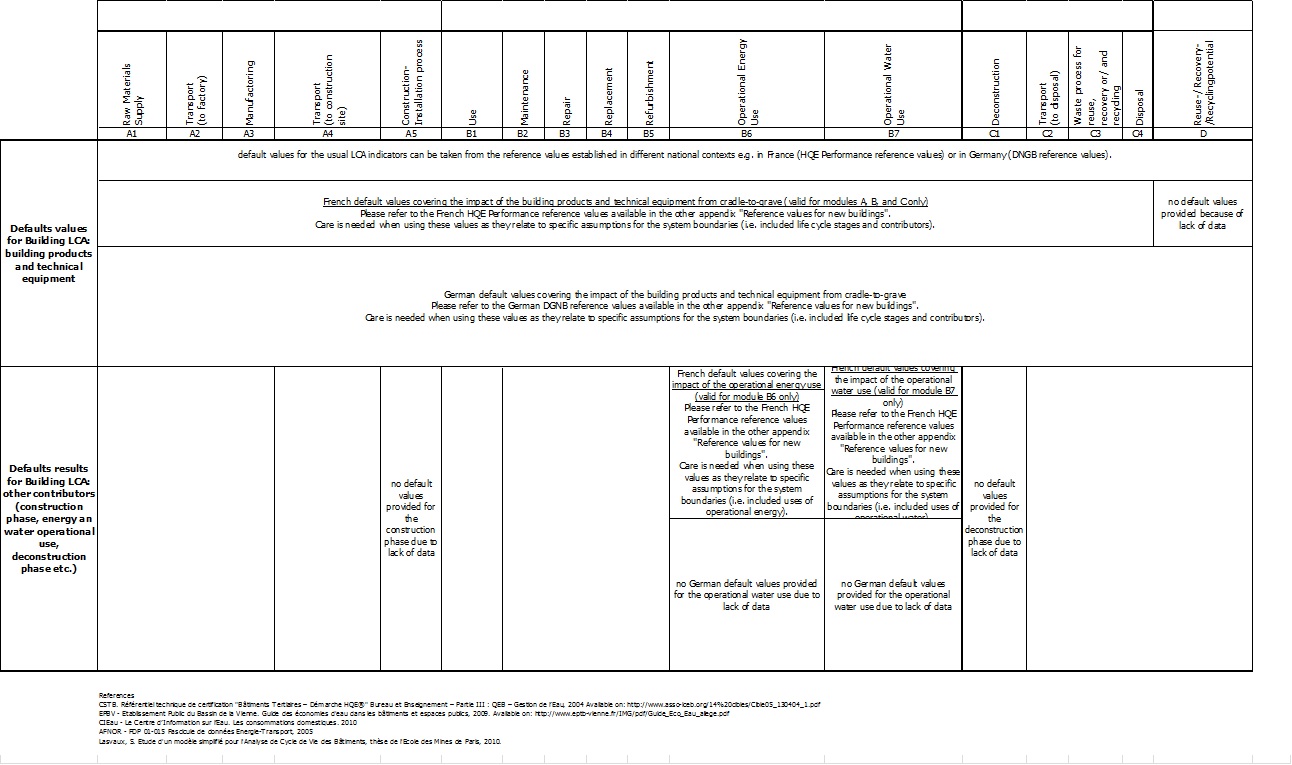
Default Values – Buildings

Back to EeBGuide Guidance Document Part B: BUILDINGS

Reference Study Period: Buildings.

Following a simplified understanding of a building’s life cycle, the reference study period can be seen as the timespan of use, i.e. the duration of services within Module B. Hence the reference study period has a significant impact on the use stage’s contribution to the life cycle impacts. This means that the reference study period influences the relation of impacts from the different life cycle stages, and thus may cause different conclusions to be drawn regarding the importance of a life cycle stage.

The following table provides definitions for reference study periods from various sources. These definitions are not based on scientifically proved lifetimes, but usually reflect a consensus, e.g. within one country.

Source Value Comments
Germany: building certification (DGNB) 50 years Default reference study period for all building types except for industrial buildings
Germany: building certification (DGNB) 20 years Reference study period for industrial buildings
Germany: building assessment (federal government) 30 years, 80 years Alternative values for scenario analyses
France 50 years, 100 years Commonly used reference study periods; no general definition available


Other default values


Annex B: Reference values for LCA indicators for buildings

For referencing purposes, typical LCA results may be helpful. These values are typically heavily dependent on the assumptions made, and on the various rules that have been applied to a study. Hence a comparison with such values has to be made with special care.

Germany: DGNB

In Germany, the DGNB building labelling system defines benchmarks for the ‘physical part of the building’, i.e. the combination of building construction (Modules A1–A3), maintenance and refurbishment (Modules B2–B5) and the end of life (Modules C and D). All DGNB rules and provisions (e.g. reference study period) apply to allow for a justified comparison.


France: HQE Performance

The following tables present the results of a French pilot project, called HQE Performance, concerning the LCA of 74 low-energy buildings. The building LCA tool ELODIE has been used to perform the life cycle assessment of every case study. Results are presented as mean values calculated for the construction of new buildings for a 50-year reference study period.
The following building types are considered:

  • detached houses;
  • multi-residential buildings;
  • office buildings

Reference values are detailed for the following building impact sources:

  • equipment, products and materials (from cradle to grave, i.e. Modules A, B, C);
  • operational water consumption (Module B7);
  • operational energy consumption (thermal regulation uses, Module B6);
  • operational energy consumption (other uses, Module B6).


Reference values for new buildings

Note: The four indicators considered (non-renewable primary energy, global warming potential, inert waste and water consumption) are calculated according to the rules given in the French XP P01-020-3 and NF P01-010 standards.

Annex C: List of available references for life cycle impact assessment indicators chosen in EN 15804/EN 15978

This Annex provides the practitioner with the sources of recommended LCIA methods (when they are in agreement with the EN 15804/EN 15978 standards). It also highlights the current inconsistencies between the units of the ILCD-recommended LCIA methods and the units of the EN 15804/EN 15978 standards.

The practitioner should notice that while different impact assessment methods are recommended by the ILCD Handbook or given in the EN standards, one cannot be sure that LCA data (both generic LCA background databases and EPDs) do support the application of an LCIA method. The practitioner has rather to evaluate data availability (among other decision criteria) before deciding on which impact methods to use.

Background information in EN 15804/EN 15978

The EN 15804 standard states that

“The impact assessment should be carried out for the following impact categories:

  • global warming
  • ozone depletion
  • acidification of land and water
  • eutrophication
  • photochemical ozone creation
  • depletion of abiotic resources (elements)
  • depletion of abiotic resources (fossil)

The characterization factors applied in the European Reference Life Cycle Database (ELCD) provided by the European Commission (DG Joint Research Centre – Institute for Environment and Sustainability) should be used and shall follow the respective updates of the ELCD [EN 15804]. In addition, the characterization factor for ADP (elements and fossil) shall be taken from CML (Institute of Environmental Sciences, University of Leiden, The Netherlands). The characterization factors for ADP-fossil fuels are the net calorific values at the point of extraction of the fossil fuels.”

References that can be considered for the impact category given in EN 15804/EN 15978

There is a need to specify the reference (scientific articles, scientific reports etc.) for each impact category, as the LCA practitioner can find several methods and characterization factors within one impact category (e.g. photochemical ozone formation). At the same time, the International Reference Life Cycle Data System (ILCD) has recently provided recommended methods for each impact category. It is proposed here to identify, for the EN 15804 impact categories, the available references and characterization factors that can be applied when using the EeBGuide.

Three reports were used to derive the references for LCIA indicators given in the EN 15804/EN 15978 standards.

– Analysis of existing Environmental Impact Assessment Methodologies for use in Life Cycle Assessment (First edition);

– Framework and requirements for Life Cycle Impact Assessment models and indicators (First edition);

– Recommendations for Life Cycle Impact Assessment in the European context (First edition, December 2010).

References of ILCD-recommended LCIA methods that may be used when applying the EeBGuide in the framework of EN 15804/EN 15978 impact categories

The first table presents the references of the ILCD recommended LCIA methods that could be used when applying the EeBGuide. A comment below the unit of the LCIA indicators indicates whether it is consistent with the unit given in EN 15804 and EN 15978.


Impact category in EN 15804

Parameter in EN 15804

Unit of LCIA indicator referring to method given in next column

Sources of recommended LCIA method based on ILCD Handbook

Global Warming

Global warming potential, GWP;

kg CO2 equiv

(compliance with the unit given in EN 15804/EN 15978)

ILCD-recommended LCIA method: Climate change; midpoint; GWP100;


Source: Forster, P., Ramaswamy, V., Artaxo, P., Berntsen, T., Betts, R., Fahey, D.W., Haywood, J., Lean, J., Lowe, D.C., Myhre, G., Nganga, J., Prinn, R., Raga, G., Schulz, M. and Van Dorland, R., (2007). Changes in Atmospheric Constituents and in Radiative Forcing. In: Climate Change 2007: The Physical Science Basis IPCC 2007. Contribution of Working Group I to the Fourth Assessment Report of the Intergovernmental Panel on Climate Change.

Ozone depletion

Depletion potential of the stratospheric ozone layer, ODP

kg CFC 11 equiv

(compliance with the unit given in EN 15804/EN 15978)

ILCD-recommended LCIA method: Ozone depletion; midpoint; ODP;


Source: World Meteorological Organization, 1999: Scientific assessment of ozone depletion: 1998. Global Ozone Research and Monitoring Project – Report no. 44. Geneva.)

Acidification for soil and water

Acidification potential of soil and water, AP;

moles H+ equiv

(no compliance with the unit given in EN 15804/EN 15978)

ILCD-recommended LCIA method: Acidification terrestrial and freshwater; midpoint; Accumulated Exceedance


Source: Seppälä, J., Posch, M., Johansson, M., Hettelingh, J.P. (2006). Country-dependent Characterisation Factors for Acidification and Terrestrial Eutrophication Based on Accumulated Exceedance as an Impact Category Indicator. International Journal of Life Cycle Assessment 11(6): 403-416.


With updated characterization factors available in:

Posch, M., Seppälä, J., Hettelingh, J.P., Johansson, M., Margni M., Jolliet, O. (2008). The role of atmospheric dispersion models and ecosystem sensitivity in the determination of characterisation factors for acidifying and eutrophying emissions in LCIA. International Journal of Life Cycle Assessment (13) pp.477–486


Eutrophication

Eutrophication potential, EP

moles H+ equiv

(no compliance with the unit given in EN 15804/EN 15978)

ILCD-recommended LCIA method: Eutrophication terrestrial; midpoint; Accumulated Exceedance;


Source: Seppälä, J., Posch, M., Johansson, M., Hettelingh, J.P. (2006). Country-dependent Characterisation Factors for Acidification and Terrestrial Eutrophication Based on Accumulated Exceedance as an Impact Category Indicator. International Journal of Life Cycle Assessment 11(6): 403-416.

With updated characterization factors available in:

Posch, M., Seppälä, J., Hettelingh, J.P., Johansson, M., Margni M., Jolliet, O. (2008). The role of atmospheric dispersion models and ecosystem sensitivity in the determination of characterisation factors for acidifying and eutrophying emissions in LCIA. International Journal of Life Cycle Assessment (13) pp.477–486


Other source: [Guinée 2001]

Photochemical ozone creation

Formation potential of tropospheric ozone, POCP;

kg Ethene equiv

(compliance with the unit given in EN 15804/EN 15978)

ILCD-recommended LCIA method: Photochemical ozone formation; midpoint – human health; POCP;


Source: Van Zelm, R., Huijbregts, M.A.J., Den Hollander, H.A., Van Jaarsveld, H.A., Sauter, F.J., Struijs, J., Van Wijnen, H.J., Van de Meent, D. (2008). European characterization factors for human health damage of PM10 and ozone in life cycle impact assessment. Atmospheric Environment 42, 441–453.


Depletion of abiotic resources: elements

Abiotic depletion potential (ADP-elements) for non-fossil resources

kg Sb equiv

(compliance with the unit given in EN 15804/EN 15978)

ILCD-recommended LCIA method: Resource depletion- mineral, fossils and renewables; midpoint; abiotic resource depletion; The ILCD Handbook recommends using the reserve base


Source:

ADP-elements based on an update of characterization factors for elements and additional characterization factors have been listed on the basis of USGS economic reserve and reserve base figures in addition to the ultimate reserve by:

Oers, L. van, A. de Koning, J.B. Guinée & G. Huppes, 2002. Abiotic resource depletion in LCA – Improving characterization factors for abiotic resource depletion as recommended in the new Dutch LCA Handbook. DWW report, Delft; see http://www.cml.leiden.edu/research/industrialecology/researchprojects/finished/abiotic-depletion-lcia.html


Depletion of abiotic resources: fossil fuels

Abiotic depletion potential (ADP-fossil fuels) for fossil resources

MJ, net calorific value

(compliance with the unit given in EN 15804/EN 15978)

ILCD-recommended LCIA method: Resource depletion- mineral, fossils and renewables; midpoint; abiotic resource depletion;


Source:

ADP-fossil fuels based on low heating values (LHV) of the fossil fuels. The fossil fuels are considered to be fully substitutable. Factors provided by: Oers, L. van, A. de Koning, J.B. Guinée & G. Huppes, 2002. Abiotic resource depletion in LCA – Improving characterization factors for abiotic resource depletion as recommended in the new Dutch LCA Handbook. DWW report, Delft; see http://www.cml.leiden.edu/research/industrialecology/researchprojects/finished/abiotic-depletion-lcia.html


* CF are provided by [Oers 2002]

Link to online characterization factors of the ILCD-recommended LCIA methods that may be used when applying the EeBGuide in the framework of EN 15804/EN 15978 impact categories

MS Excel CF: http://lct.jrc.ec.europa.eu/assessment/resolveuid/cdfa2451af584ec3b3056a17060e4b6f (RAR-File)

ILCD formatted: http://lct.jrc.ec.europa.eu/assessment/resolveuid/0e0eb8ac1856f79a0a3816f20514b8db (ZIP-File)


References of other LCIA methods that may be used when applying the EeBGuide in the framework of EN 15804/EN 15978 impact categories

As for some ILCD-recommended LCIA methods, there is not a consensus with the standards (e.g. a different unit is proposed in the ILCD-recommended method). The practitioner can have a look at the online ILCD report for more information on the other LCIA methods:

http://lct.jrc.ec.europa.eu/assessment/LCIA-CF-09-02-2012-def.pdf

The CML 2002 LCIA method has also been very much used in practice for many years. The practitioner who would like to consult the online characterization factors can go to the following link:

http://cml.leiden.edu/software/data-cmlia.html

Please note that the units for AP and EP in the CEN TC 350 standards correspond to the CML 2002 LCIA method.


Concluding remarks:

A list of references for each impact category has been given, based upon the ILCD Handbook recommendations.

It should be kept in mind by the practitioner that there is still quite some freedom when applying the EeBGuide for different impact categories: acidification and eutrophication as the units (and thus the methods) differ between the EN 15804 standard and the ILCD recommend methods. In addition, some of the newly ILCD-recommended methods may not be implemented in commercial LCA software such as GaBi or SimaPro. Also, generic background databases and EPDs may not necessarily contain impact factors or indicator values for all of the methods listed. This situation, however, is expected to change and improve over time.


2.4.1. How to commence and proceed with an LCA study

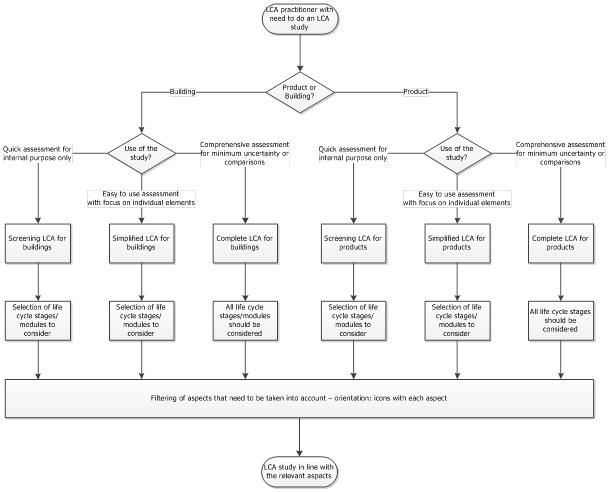
This document yields several distinctions that are relevant for the further procedure to compile an LCA study. The distinctions are given in the decision tree showed in Figure 5.

In the first step, both for a building LCA and a product LCA, the decision on the scope of the study has to be made. This leads to the definition of the study type used and the relevant aspects to assess may be filtered accordingly for the next steps. This includes the identification of life cycle stages that should be assessed and those that will remain optional. Refer to Table 3 for the identification of mandatory and optional life cycle stages.

On the basis of the study type chosen and the life cycle stages of concern, the remaining relevant aspects are then taken into account during the setup of the LCA building model and for defining individual parameters of the system.

As the term “energy efficiency” implies a lower energy input into a building or building service through a more advantageous benefit/input ratio, a comparison of the situation with or without the technology concerned may be required to identify the actual environmental consequences of utilizing such a technology. It needs to be noted that the careful definition of the two situations and a comprehensive life cycle view (inclusion of all relevant life cycle stages) is necessary to cover all environmental consequences. In addition, comparison should be done on the basis of a common functional equivalent (i.e. a representation of the required technical characteristics and functionalities of the building).


2     How to use this Guidance document

Back to EeBGuide Guidance Document Part B: BUILDINGS


2.4.2. LCA study setup: Generic template

After the selection of the study type and the subsequent filtering of aspects, the LCA study is set up according to the general LCA practice as resulting from applying ISO 14040/14044. This process is briefly explained with a generic template of how to set up an LCA study. The individual steps are numbered – note that this numbering does not relate to any study or other procedure that is defined elsewhere.

Step 1 – Goal and Scope definition

The definition of goal and scope mainly relates to the identification of study type and aspects considered for the LCA study as described in section 2.4.1. Based on the definition of reasons for carrying out the study as well as its intended application and audience, further specifications have to be made, e.g.:

  • Object of assessment (e.g. building or innovative technology) and its function (e.g. office use or energy producing façade collector)
  • Set up of a functional equivalent – special especially important for comparative assertions
  • System boundaries – specifications on life cycle phases to be included (e.g. for existing buildings) depending on the study type or hints for applying cut-off rules (e.g. with regard to infrastructure and transport) are specified
  • Procedure for allocation – several common allocation cases (e.g. for co-production or reuse and recycling) with regard to mass, energy or environmental significance are provided
  • Choice of environmental impact categories, indicators and characterization models used for the impact assessment
  • Data requirements and quality – the type of data to be used (e.g. generic or specific), data uncertainty, the use of foreground or background data (e.g. power-mix) and specific requirements on data quality for comparative assertions are defined; missing data have to be documented
  • Assumptions and limitations – may address e.g. the setup of specific scenarios for the use phase, the treatment of capital equipment or machinery within the production phase, or deviations from guidance provided within this document; a transparent documentation is required

Examples and guidance on the mentioned topics are provided within respective aspects of the chapters for “Goal and Scope definition”.

Step 2 – Inventory Analysis and Product Model

The way of data collection as well as the quantification of input and output flows (e.g. materials or energy) differs for screening, simplified and complete LCA studies and depends on the level of separating single elements for the object of assessment as well as the assessed life cycle stages . Data sources (e.g. public available or company/product specific ones) used and the quality of background data for the inventory analysis have an influence on the impact assessment. Guidance on data collection, calculation, validation and relating the information to e.g. life cycle stages or elements of the object of assessment is provided within the chapters for “Life cycle inventory analysis”. Furthermore, building and building product contributors are defined which have to be considered.

Step 3 – Impact Assessment

For the quantification of potential environmental impacts, the choice of environmentally relevant, technical and scientifically valid environmental indicators as well as the underlying characterization models for impact assessment, is of importance. Environmental indicators and impact categories where scientific consensus is not yet reached so far (e.g. water consumption, land use change or carbon sequestration) are addressed within the chapters for “Life Cycle Impact Assessment”.

Step 4 – Interpretation and Documentation

The interpretation of results serves e.g. for identifying hot spots (e.g. distinct life cycle phases or elements of the object of assessment contributing to environmental impacts) or understanding sensitivity and uncertainty of results through respective analysis. Requirements and guidance on the use of normalization, grouping or weighting are provided within the chapters for “Interpretation”. Cases, where a sensitivity analysis is useful, are defined as well.

Reporting templates are provided online at the official project website (https://www.generis-solution.eu/) and assist especially in conducting step 1. These templates form the basis for a documentation which is in-line with the present guidance document and which might be enhanced with further specific information, if required or recommended (e.g. if future technologies and innovations are regarded at).

Step 5 – Review

An external critical review is necessary for all comparative LCA studies or studies which are made public available. Guidance on simplifications for the review of stand-alone or screening LCA studies or studies within the E2B EI is provided under section “Reporting” within chapter “General aspects”.


2     How to use this Guidance document

Back to EeBGuide Guidance Document Part B: BUILDINGS


2.4.3. Use of a baseline scenario

Several of the aspects addressed in this guidance define a ‘standard set of parameter values’ for a study, e.g. a default reference study period. This standard set of parameter values is denoted as baseline scenario and provides a basis that allows for comparisons between different studies, e.g. two building LCA studies. The baseline scenario generally contains the definitions and parameter value choices from EN 15804 (products) and EN 15978 (buildings).

Additionally, standard values for a parameter frequently contain options to explore the implications of different choices (e.g. reduced or extended reference study periods). If such deviations are chosen, sensitivity analysis has to be undertaken to compare the new scenario against the baseline scenario in order to explore the influence of the parameter value on the results. Then, results with the use of the default parameter value (baseline scenario) and with modified parameter values (assessed situation) should be compared.

The baseline scenario (i.e. standard set of parameter values) contains the following provisions:

Table 4: Standard set of parameter values for the baseline scenario

Aspect

Parameter

Standard parameter value

G- 04. “Reference study period”

Reference study period

50 years

G- 10. “Future technical developments and innovation”

Consideration of innovation

No innovation to be considered, current technologies to be used

G- 12. “Accounting for carbon storage / carbon sequestration”

Carbon storage

Carbon storage is not considered

G- 25. “Water consumption”

Scarcity of water

Not scarcity of water to be considered

A- 03. “Transportation of products to the construction site” – screening and simplified LCA”

Transport distance

293 km

A- 04. “Transportation of products to the construction site – Complete LCA”

Transport distance

293 km

B- 03. “Transport of people”

Transport of people

No transport of people to be considered

B- 13. “Replacement frequency”

Full numbers of replacement cycles or partial cycles

Replacement in whole number cycles

B- 20. “Electricity consumption in dynamic LCA data”

Electricity consumption

Annual average data sets for electricity

B- 25. “Operational energy demand – Consideration of user behavior for stand-alone or comparative LCA of new buildings”

User behavior

No user behavior to be considered

2     How to use this Guidance document

Back to EeBGuide Guidance Document Part B: BUILDINGS