1.3.2 European standardization works on LCA of buildings

LCA, as an instrument to assess the environmental performance of buildings and building products, is generally seen as a way to provide a holistic overview of a building’s or product’s life cycle. It is generally standardized in ISO 14040 and ISO 14044 as an instrument to assess the environmental performance of products and services. For the construction sector, it is now subject to the standardization activities of the European standardization body CEN TC 350’s committee on sustainability of construction works.

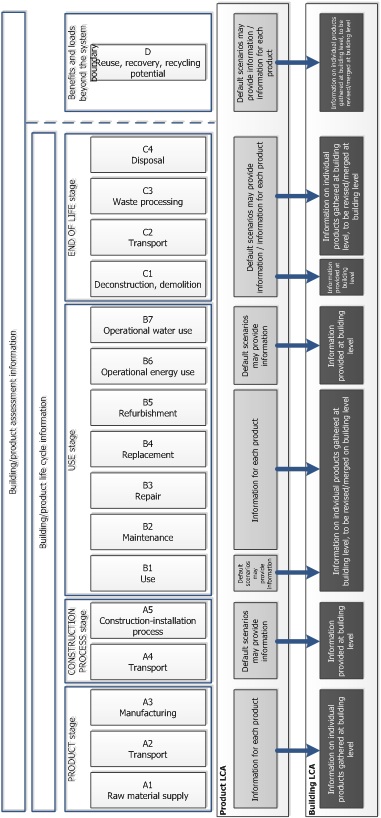
The European standards EN 15804 and EN 15978 provide general calculation rules for LCA of products and buildings. Both standards use a modular description to structure information for the various stages of the building or product life cycle. For some modules, information is provided primarily at the product level; for other modules, it is typically gathered at the building level. Information on the production and assembly of building products (Modules A1–A3) is typically assessed in detail in product LCA studies. In building LCA studies, this information is aggregated to reflect product utilization within the building. Information on operational energy use (Module B6), on the other hand, may be provided for individual products with the use of default scenarios, but information on actual operational energy use is generally gathered within a building LCA study. These relations are reflected in Figure 2.

Figure 2: Relation between product LCA and building LCA along the life cycle modules. Figure based on EN 15804and EN 15978


1 Introduction

1.3.3 LCA studies within research projects of the Energy-Efficient Building European Initiative (E2B EI)

In numerous European research projects, LCA is used as a supporting study method that is typically seen to be somewhat independent from the rest of the project. If, for instance, LCA is used at the end of a project, the environmental optimization potentials cannot be exploited, as the LCA results cannot be fed back into the technology development cycle.

This guidance document is aimed at improving the use of LCA within such research projects. This chapter therefore gives guidance on how LCA studies should preferably be conducted in European research projects of the Energy-Efficient Building European Initiative (E2B EI).

The primary decision to be made during the compilation of a project proposal is whether LCA should be used as a comparison method for a developed technology (i.e. the developed technology is assessed against a reference scenario that, for example, reflects the conventional alternative technology), or whether it should be used as a decision support tool, identifying environmental weak points in technical designs and associated improvement potentials that can be realized during technology development. In both cases, certain considerations need to be addressed.

For LCA as an ex-post assessment of a developed technology, such considerations include the following:

  • Data supply: The critical barrier to obtaining meaningful LCA results is the lack of specific data. LCA is typically not taken into consideration during technology development processes, and no responsibility is defined for the provision of data. Moreover, intellectual property concerns may hinder the provision of data.

This needs to be taken into account by ensuring that, within the work items of technology development, one or several participants are mandated to provide information to the LCA work team.

  • Definition of objectives for the LCA study: Often, the expectations of participants in a research project concerning the results available from the LCA study do not match the results that the study can provide.

Within a project consortium, the expected and possible outcome of an LCA study should be made clear for all stakeholders involved. This includes discussion of the questions that the study needs to answer, the associated level of detail for the study, and the corresponding requirement for data. Also, sufficient resources need to be allocated to the LCA work item to meet the expected outcome.

  • Usually, it is advisable to define one stand-alone work item (a work package or a task within a work package) for the LCA calculation, and to define data collection for the LCA study as part of technology-related work packages. LCA is a flexible and iterative methodology, and the findings and results of its various steps will influence subsequent ones. For this reason, it is also advisable that the LCA work item duration be suitable and sufficient to provide relevant feedback to other work items of the project.

For LCA as a decision support tool in technology development, such considerations include the following:

  • Integration into the development cycle: To use LCA as a supporting tool within technology development, the LCA study work item should be included directly in the technology development work item. This supports direct interaction between the LCA experts and the technology development experts, and ensures direct data exchange. It also means that procedures need to be established that allow the technology development to consider relevant LCA results, and that the exchange between technology development and the LCA study needs to be set up with iterative cycles.
  • Iterative approach to LCA: The results are only as meaningful as the technical data that is fed into the LCA calculations. This means that a procedure should be established that takes account of the fact that imprecise data are provided in the early design stages, and that imprecise LCA feedback is provided then. With several iteration cycles, the data provision and LCA feedback have to be refined in a stepwise fashion.
  • Such a use of LCA is challenging, because it requires significant flexibility from all actors, and asks for innovative development procedures. But it also it has the potential to yield the best outcome in terms of improving the environmental performance of a technical system, which should always be the ultimate goal of using environmental assessment methods.

1 Introduction

1.4 EeBGuide within the European context

The primary objective of the EeBGuide is to provide consistent calculation rules and operational guidance for LCA studies conducted within the context of research projects within the Energy-Efficient Buildings European Initiative (E2B EI, or Energy-Efficient Buildings Public Private Partnership, EeB PPP). Such research projects use LCA for supporting decisions during the development of technologies, and/or as an assessment method for quantifying the environmental benefits of innovative technologies (see 1.3.3). LCA studies – whether they cover comparative assertions or investigate individual products or buildings – are intended to be comparable in the wider context of the E2B Initiative. This means that they should be based on similar methods, assumptions and mechanisms, and yield credible, comparable results.

To give the full picture of the EeBGuide, it is useful to understand how it is embedded in the European context, and to discuss what its role could be within this context. Figure 3 illustrates the current, potentially confusing situation relating to EPDs, building LCA, building labelling and legislative activities in the European context.

 Figure 3: Current European situation in the context of EPD and building LCAs

LCA is currently used as the basis for product assessments, and especially in providing EPDs, which form an important data source for building assessments used in building labelling schemes. This basis is not consistently defined by the various standards and the ILCD Handbook; definitions may conflict, and different approaches to conducting a study may be chosen. The forthcoming Construction Products Regulation (CPR) [CPR 2011] contains additional Basic (Work) Requirements (BWR), particularly the addition of ‘environment’ to BWR 3 (hygiene and health) and the new BWR 7 (Sustainable use of natural resources), stating that “EPD should be used when available for the assessment of the sustainable use of resources and of the impact of construction works on the environment.”

Both the European standards EN 15804 and EN 15978 and the ILCD Handbook are based on the international standards ISO 14040 and ISO 14044. The European standards define the general framework and general calculation methods for building and product LCAs. The European ECO EPD platform (as the potential umbrella body for national EPD programmes) and national EPD programmes have individual sets of rules, and may refer to EN 15804. Building labelling schemes (such as DGNB, HQE, VERDE or BREEAM) use their own individual sets of calculation rules for building LCA, and may refer to EN 15978. As a consequence, the European landscape of LCA calculation rules is currently not harmonized, and the links between EPD data and building LCAs (which use EPD data for the products used) are not necessarily well established. However, the ongoing efforts of projects such as SBA Common Metrics are contributing to the development of common rules.

In the field of legislation, the revision of the Building Products Directive (CPD) to the Building products Regulation (CPR) has created a demand for building product EPDs as a mechanism to meet the additional requirements (see above). Consequently, building product manufacturers are faced with the need for EPDs for their products, and the subsequent provision of such EPDs will lead to a stock of product-specific environmental information not seen to date. The utilization of such information may well lead to a wide use of LCA for assessing the environmental performance of buildings. One core requirement for such an application is consistency between data supply (product data/EPD) and data use (building LCA). In this context, consistency will be enhanced by this guidance document, which represents an excellent step towards consistent LCA calculation models within the European construction industry.

Figure 4 illustrates the link that the EeBGuide is able to establish between the various standards, building labelling schemes, EPD programmes, legislation and other items within the European context.

Figure 4: EeBGuide within the European context

Altogether, several dimensions of impact and scope can be associated with the EeBGuide. These impacts are explained in more detail in the following paragraphs.

Impact on LCA practitioners and technology development within E2B EI research projects

The EeBGuide enables LCA practitioners, from both private and public organizations, to quantify environmental impacts in a consistent way. The guidance can be applied in assessing the life cycle of whole buildings (existing and new) and of existing building products and technological solutions (existing or under development) within the E2B Initiative. It allows practitioners to perform LCA studies in a clear, predefined and well-structured way by delivering scientifically sound, practically applicable, and quality-assured guidance. In addition, high-quality life cycle inventory (LCI) data on buildings and building products can be obtained by following the EeBGuide, applying time- and cost-saving mechanisms for conducting future LCA studies and providing reporting templates.

By using the guidance document in future studies (beyond the FP7 arena), the EeBGuide will help LCA practitioners to produce more robust, harmonized, and quality-assured LCA results. The ability to quantify the environmental performance of newly developed products consistently, and to compare this performance with that of existing products, may lead both to the reduction of their environmental impacts and to significant promotion of these new products, and thus contribute considerably to technology development in the EU.

Impact on building labelling schemes and national EPD programmes

Labelling schemes for sustainable buildings have received tremendous attention over recent years, and are seen as a major driver for innovation and implementation of sustainable thinking in the European construction sector. This document, and the additional reporting templates for buildings, may quite likely form a basis for integrating LCA into labelling schemes. In this context, building LCA depends strongly on calculation methods that are suitably applicable to such studies, and on reliable data for individual construction products. Such data may be provided by the EPDs of manufacturer-specific products, or by generic LCA data for average construction products. For the purpose of setting up generic databases, and to enable a growing number of LCA experts to contribute to that task, common rules and specifications as well as guidance will be required, and these are provided by the EeBGuide.

For the further consideration of aspects related to building labelling, relevant stakeholders have been invited to participate in the public consultation on the EeBGuide. Special attention has therefore been paid to the expected impacts of the EeBGuide on labelling schemes, and to the potential resulting benefits and opportunities for stakeholders.

This EeBGuide may also have an impact on the various EPD programmes throughout Europe. Although EPD programmes generally provide the required provisions for conducting the LCA study for an EPD, these provisions may differ between different EPD programmes, and operational guidance on how to conduct the product LCA study may be missing. The EeBGuide will be useful in the formulation of Product Category Rules (PCR) as the basis for EPD for ‘new’ product categories, or for EPD programmes that are being newly established. In particular, for innovative solutions that are currently under development, or which will be developed within the Energy-Efficient Buildings Initiative, guidance on how to conduct an adequate study may help the formulation of appropriate PCRs. Here, the EeBGuide may yield useful guidance.

Impact on standards, legislation and political background

In the past, practice in building-related LCA studies has been quite diverse. On the one hand, the building and construction sector appeared to be the most advanced sector in terms of ongoing standardization activities concerning LCA studies. On the other hand, many LCA studies are still conducted without proper (or even any) reference to current standards, because of a lack of either resources or knowledge concerning the existing standards and ongoing standardization activities.

Current and recent activities cover both the definition of LCA calculation rules in detail for building labelling by individual labelling schemes (for example, the German DGNB scheme includes building LCA on the basis of very specific rules) and framework standardization activities such as those developed within CEN TC 350. A general consensus is needed for the future development of LCA methodology, but the resulting standards do not advise the practitioner in sufficient detail on how to conduct a study.

In this context, the EeBGuide fills a current gap, and thereby has the potential to reach beyond the impact originally anticipated within the E2B Initiative. With regard to current and future standardization activities, the EeBGuide may serve as a guideline for the development of directly applicable and highly operational standards for the application of LCA within the building and construction sector, and possibly even within other sectors. This would result in generally improved quality and scientific soundness of LCA studies within the E2B Initiative and beyond. In this way, the EeBGuide will enables legislative bodies to place greater reliance on LCA as a policy instrument. It will increase the usefulness of LCA studies, and foster their use in decision support and policymaking, ensuring that decisions and policies are formed on the basis of integrated environmental assessments.

At the European policy level, the EeBGuide will provide a direct link from the construction industry to the European Platform on LCA and the ILCD data network. In addition, this guide will have an indirect impact on the following European policies:

  • The Integrated Product Policy (IPP) Communication (2003), which aims to provide general support, through a series of broad activities and measures, for reducing the environmental impacts of goods and services (products) throughout their life cycle. According to the IPP, LCA is the best framework for assessing the potential environmental impacts of products. Following the IPP, the European Commission has developed the ILCD Handbook, among other activities. This EeBGuide uses the ILCD Handbook to give more pragmatic and specific guidance to LCA practitioners within the construction sector.
  • The Thematic Strategy on the Prevention and Recycling of Waste, and the Thematic Strategy on the Sustainable Use of Natural Resources, both from 2005, which tackle the topic from the waste and resource sides respectively. A key development of the Resource Thematic Strategy is the development of decoupling indicators for Europe. Key deliverables of the Waste Thematic Strategy are the development of waste guidelines. LCA in general and the EeBGuide in particular have the potential to address related issues, with the use of appropriate environmental indicators and the assessment of impact categories.
  • The new Construction Products Regulation (CPR) has amended the third basic work requirement with the reference to environment and added the seventh basic work requirement, sustainable use of natural resources. The amended and the new basic work requirements will need quantitative assessment on the amount and type of resource consumption related to one product, and the European Parliament suggested the use of EPD for this purpose. As the CPR will have to be broadly implemented in the harmonized European product standards, standardization for such LCA studies in conjunction with intensive guidance is required, and the EeBGuide will contribute to the provision of such guidance, in support of EPD programmes and of both published and forthcoming CEN standards.
  • The Lead Market Initiative for Europe on Sustainable Construction, in which LCA is directly mentioned as a means to describe sustainable construction and an integrated life-cycle-oriented approach to construction, which is seen as an approach to the successful promotion of sustainable construction.
  • The most important and recent instruments are the Sustainable Consumption and Production Action Plan (SCP) and the Sustainable Industrial Policy (SIP). SCP and SIP will build on, and further develop, among others, the Integrated Product Policy (IPP), the Resource and Waste Thematic Strategies, Green Public Procurement (GPP), the Environmental Technologies Action Plan (ETAP), and the Eco-label and Eco-Management and Audit System (EMAS) Regulations. It will also further develop the Energy-using Products Directive (EuP). The JRC-IES, with its European Platform on LCA project (ILCD data network), is mandated to support the implementation of the SCP with data and methods.

Social impact

The social impacts derived from the development of this EeBGuide can be diverse in nature. Among the most relevant ones are the creation of new, high-technology jobs by improving Europe’s competitiveness, healthy and secure working conditions, and the general well-being offered by a healthy environment. These are the impacts that can be directly linked with technologies, and their contribution to our future lives. The integration of participatory approaches into the development of this guidance document strengthens these aspects of the social impact, contributing to a more democratic and more knowledge-based society.

Impact on European competitiveness

The EeBGuide will enhance the competitiveness of European industry by its contribution to sustainable development. It supports the goal of decoupling growth from resource depletion, which is an economic, environmental, and social necessity for European industry. Assessing and improving the environmental performance of products, technologies and services, EeBGuide delivers the framework for a consistent environmental evaluation.


1 Introduction
2.1 Identification of important aspects for product and building LCA studies

The EeBGuide benefits from a comprehensive approach to identifying key aspects of the LCA methodology applied to products and buildings that need further clarification. Using the steps of the LCA framework (goal and scope definition, inventory analysis, impact assessment, interpretation), as well as the life cycle stages of a building from cradle to grave, allowed identification of aspects where provisions and guidance were missing. The need to adapt the guidance to different stakeholders and different stages of a project also led to the definition of different study types: screening, simplified and complete LCA (see below).

The various aspects were defined based on literature searches, analysis of reference documents (see below), and consultation with LCA experts during brainstorming meetings among the EeBGuide partners. For example, aspects such as definition of the functional unit for a product, the use of EPD data in building LCA studies, end-of-life scenarios, the choice of environmental indicators, and the normalization step led to many questions that need to be addressed, and provisions and guidance clearly documented.


2     Methodological approach of the EeBGuide.

2.2 Reference documents for the EeBGuide

The EeBGuide refers to several sources that provide rules and guidance for LCA practitioners. The first such source is the original ISO standards on life cycle assessment, i.e. [ISO 14040] and [ISO 14044]. In addition, the ILCD Handbook provides extended guidance on LCA in general. The ILCD series of technical guidance documents for LCA have been developed to support LCA practitioners in the planning, performance and documentation of complete and detailed LCAs. The recommendations given in the handbook are in line with the requirements of ISO 14040 and ISO 14044. Other important sources of guidance for the LCA practitioner are [EN 15804] and [EN 15978], which define LCA of building products and buildings more specifically. These European standards were developed by the CEN technical committee on sustainability of construction works (CEN TC 350). Other reference documents considered for setting provisions and rules were the ISO standards on service life planning (the ISO 15686 series), and various scientific reports and articles.


2     Methodological approach of the EeBGuide.

2.3 Procedure for choosing provisions from both CEN TC 350 standards and the ILCD Handbook

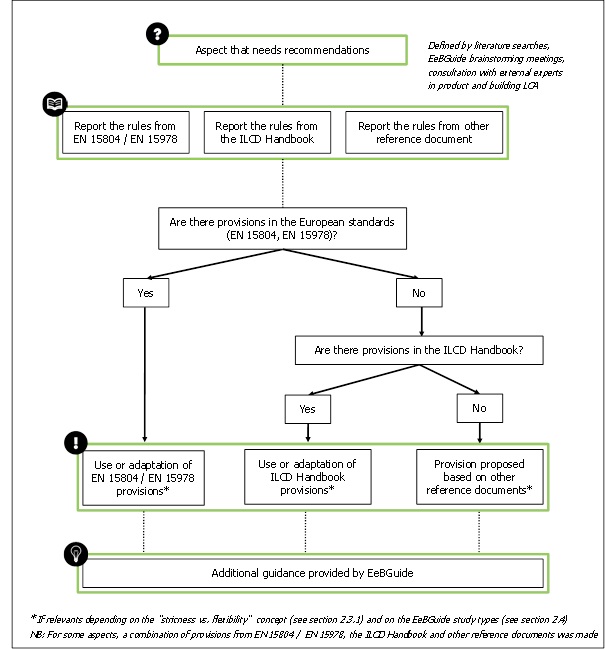
The ILCD Handbook was written by a panel of scientific researchers and experts in LCA, whereas the CEN TC 350 standards were written by a panel of building stakeholders as well as LCA experts. The level of detail varies considerably between the CEN standards (around 50 pages) and the ILCD Handbook (around 1000 pages in total). The main differences between the ILCD and CEN TC 350 standards can be found in their terminology and provisions. For example, EN 15804/EN 15978 proposed new terms such as the ‘functional equivalent’ of a building to adapt the ‘functional unit’ term defined in ISO 14040 and in the ILCD for the building sector. As a result, these documents may often conflict in the definition, the level of detail and finally the provisions to adopt for each LCA step, and for each life cycle stage. A systematic procedure was therefore adopted in the EeBGuide for choosing the basis of the guidance included for each aspect.

As mentioned above, the EeBGuide tries to combine provisions and guidance from the EN 15804 and EN 15978 standards and the ILCD Handbook (see Figure 5). If cases of contradictory approaches appear in the reference sources, then the EeBGuide always tries to state a provision or guidance transparently for both the standard and the ILCD Handbook. As far as possible, the EeBGuide provisions follow the European standards [EN 15804] and [EN 15978] closely. If the standard does not mention a certain aspect, or if it is not very clear on that aspect, provisions and guidance from the ILCD Handbook are provided. Where no existing guidance is available, other provisions are proposed by the EeBGuide.

Figure 5: Procedure for adaptation from the CEN TC 350 standards and ILCD Handbook

Guidance can include links to further interesting or important information, or to examples, or present an interpretation of the standard or the ILCD Handbook. This interpretation is not meant to be a provision, but rather a means to share LCA experiences from LCA practitioners and experts.


2     Methodological approach of the EeBGuide.

2.3.1 EeBGuide provisions for different goal definition: strictness vs. flexibility

LCA has been developed as a flexible system that can be adjusted to answer different kinds of question [CALCAS 2009]. In this context, standardization is always a difficult task, as it is done under a specific goal definition (e.g. EN 15804 is developed for giving rules for EPD). According to [CALCAS 2009], standards contribute to the harmonization of terms and procedures that are needed for comparison (as practised by rating agencies or consumer agencies). Thus standardization is often not helpful for the optimization of specific processes. Individual concepts that address the specific problems and goals are often more appropriate for such cases.

The practitioner should be aware that for some key aspects, such as goal definition, following the ILCD Handbook may lead to provisions that are different from those in the EN 15804/EN 15978 standards. Hence it is very important to distinguish the different provisions found in the EeBGuide. Although some provisions can be used for all studies, others may be used only under the goals and scope of the EN 15804/EN 15978 standards. For example, most of the time provisions for product LCA are in line with EN 15804.

The EeBGuide has two related objectives when choosing provisions from both CEN TC 350 standards and the ILCD Handbook. First, it is structured in line with the EN 15804 and EN 15978 standards (Modules A, B, C and D), so the provisions (based either on ILCD or EeBGuide) provides consistent rules for implementation of the two standards in practice. This is the ‘rigid’ part of the EeBGuide, which enables it to be in line with more operational projects such as the SBA Common Metrics. Such a perspective is more likely to fall under the secondary audience, e.g. for EPD and building certification purposes (but not only these).

Second, it is structured according to the life cycle steps of the LCA framework. It clearly defines provisions for the different goals and scope of building and product LCA studies. Here, the intention is to detail the different definitions of goal and scope that may be found in practice, for example in comparing two innovative products in an E2B EI research project, or assessing the introduction of a new technology into the market by the use of consequential modelling. This is the ‘flexible’ part of the EeBGuide. Such a perspective is more likely to fall under the primary audience, as E2B EI projects (but not only these).


2     Methodological approach of the EeBGuide.

2.4 Use of three study types

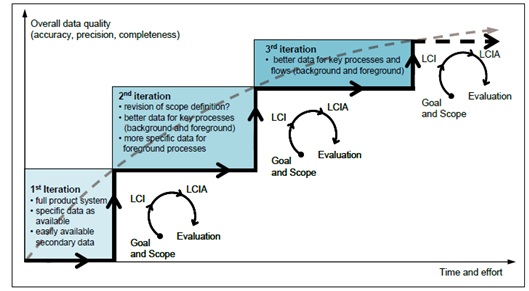
LCA studies can be undertaken to meet a multitude of different goals, and often different goals are addressed in one single study. Depending on its goals, the study will have a different scope and level of detail. Generally speaking, LCA is an iterative process, as illustrated in the ILCD Handbook (see Figure 6).

Figure 6: LCA as an iterative process [ILCD 2011a]

In the construction sector, LCA studies cannot be completed with the same level of detail as in other sectors. Users such as architects and design engineers require user-friendly tools that can be adapted to the specifics of a building project, and to their needs. An architect during an architectural competition may conduct a screening LCA for supporting his/her design alternative (first iteration in Figure 6), whereas at a more advanced stage of the building project a complete LCA may be required (third iteration in Figure 6). These different iterations will often not necessarily be performed by the same stakeholder. In each case the data, methodology and results need to be adapted to the goal of the study, and to the stakeholder’s requirements.

Within this guideline, three different LCA study types have been defined: screening, simplified and complete (see Table 5). Each LCA study for products (i.e. products, materials, components or services) or buildings can be conducted at these different levels of detail, depending on, for example, the goal and scope of the assessment, the experience of the practitioner (architect, LCA expert), the data availability, or the state of development of the product or building being assessed. These levels of detail have several implications for the following aspects:

–       Completeness of the assessment

  • System boundaries (e.g. selection of building components included, and inclusion of selected life cycle stages or information modules)
  • Calculation rules (e.g. for energy and water consumption)
  • Life cycle impact assessment (LCIA) (e.g. for number of indicators to be used)
  • Interpretation for building-level applications of the LCA results (e.g. comparability)

–       Data representativeness (e.g. use of specific or generic LCA data, input data based on estimations or on precise calculations)

–       Documentation of LCA results

–       Communication of LCA report and results

For building assessments, the aim of both screening and simplified LCAs is to simplify the completion of a building LCA study by the practitioners, for example, in the early design stages. Several aspects need to be adapted (e.g. data types and calculation rules) to streamline the LCA of buildings. For example, default values and adapted calculation rules can be used for estimating the impacts of the building components, water and energy consumption. It is also possible to adapt the system boundaries in screening and simplified LCA, for example by omitting details such as joints or individual services during the use stage.

In this guidance, as far as possible, for screening and simplified LCA the insignificance or irrelevance of a life cycle stage, or a contributor (e.g. deconstruction activities), or an indicator (e.g. ADP, GWP, POCP) should be justified by the scientific evidence for each aspect (e.g. by a comparison between a full building LCA study and a simplified one omitting one of these aspects). As far as possible, the EeBGuide supports this approach of justified, sound simplification, as shown in previous studies e.g. [Kellenberger 2009]. It enables the LCA methodology for the building sector to be streamlined, while maintaining the precision of the results as far as possible, and adapting the LCA methodology to the needs of the building stakeholders.

As a result, the EeBGuide provides mainly guidance on the data types (e.g. use of default values in early design stages) and calculation rules for both screening and simplified LCA. The final choice of omitting life cycle stages or LCIA indicators is left to the practitioner.

Note: However, it is strongly recommended that LCA studies be performed with more than one LCIA indicator, and covering several life cycle stages; the results of single-stage or single-indicator studies can be misleading, and the approach does not match life cycle thinking. Issues such as burden shifting can occur, but may not be detected, and it is the core objective of the LCA methodology to obtain a comprehensive view of the environmental performance of a technical system. As the EeBGuide is related primarily to energy-efficient buildings and products, the inclusion of at least PENRT (total use of non-renewable primary energy resources) and if relevant the GWP (global warming potential) and PERT (total use of renewable primary energy resources) is strongly recommended.

The complete LCA approach is proposed for the more advanced phases of a building project. In this case, precise calculation rules have to be followed, and comprehensive system boundaries have to be used in developing a complete LCA study.

The following section explains the different study types in more detail.

Focused assessment

The concept of life cycle assessment generally has two basic connotations:

If a practitioner concludes from the goal and scope of a study that the assessment should cover only selected life cycle stages or selected information modules, or that only one single indicator should be assessed, then the practitioner is free to do so. For example, aspects such as specific building components or services can be considered without requiring an in-depth analysis of the entire building. However, under these circumstances such a study cannot be referred to as ‘life cycle assessment’ within the context of this guidance, but should be denoted as a focused assessment.

It is strongly recommended that the calculation methods and applicable provisions given in this document be used for the elements selected for assessment, to ensure the minimum comparability for such studies.

Examples of focused assessment:

  • study focused mainly on operational energy use (B6), in order to show the results of different energy supply systems.
  • study for a facility management company, focusing on maintenance (B2), repair (B3, B4) and operational water use (B7).

2     Methodological approach of the EeBGuide.

2.4.1 Screening LCA

Purpose

A screening LCA study may serve for an initial (quick) overview of the environmental impacts of a building or a product. The challenge is to adapt the LCA methodology and simplify the use of LCA at the early design stage. With a screening LCA, it is not possible to retrieve detailed results on the environmental performance of a building or a product, and comparative assertions according to ISO 14044 cannot be based on it. Comparisons can be made internally, but these comparisons should not be published. This type of study yields an estimate of the environmental performance, which can be helpful in the early stages of design (e.g. for an architect’s draft design0 in of a research project (e.g. to identify environmental hotspots that require an additional, in-depth assessment).

Completeness of assessment

A screening study would typically focus on the main contributors to the system under assessment, including (but not limited to) the input materials, water and energy use, and the transportation of users (if relevant). In screening LCA, to avoid misleading results, care is needed to ensure that omitted building products are not significant for the chosen environmental indicators. It is also important to use adapted calculation rules for screening LCA (e.g. the use of statistical data for assessing impacts of water consumption). More information on the calculation rules can be found in Table 5.

Cut-off rules, as specified in EN 15978 and EN 15804, and in the ILCD Handbook, may not apply to screening LCA studies for buildings or products. For example, in the early design stages not all the input raw materials and components are known in detail, which means that some of them are omitted. Rather than systematically neglect them, one option is to try to model these omitted processes using default values. Generally speaking, life cycle modules, inputs and services should be omitted only if their insignificance for the corresponding environmental indicator can be scientifically justified.

A screening study might focus on one single indicator or several, and most studies should include PENRT (total use of non-renewable primary energy resources) and if relevant the GWP (global warming potential) and PERT (total use of renewable primary energy resources). As a general rule, a set of between five and seven additional relevant core LCIA indicators can be used (see the corresponding aspect in section 5). They may be taken from either EN 15804 or EN 15978, and from additional indicators described in the ILCD Handbook (if relevant for the purpose of the study).

Data representativeness

In comparison with the other study types, a screening study is likely to be based on generic assumptions, according to the goal and scope of the study. For example, if the goal is to conduct an LCA study within a European project, then the use of generic assumptions for the EU context may be sufficient. However, if the goal is (as in most cases) to conduct an LCA study that is representative within a national context, then generic assumptions for the national context are appropriate. Five major areas related to the representativeness of data can be considered: geography, technology, age, time and precision. It is also important to ensure consistency within the data used.

Geography

The data used in a screening study should, as far as is practical, given the existing time and budget constraints, relate to the country from which the building or product originates, and in which it is built or produced. However, as this is not always possible, it is also acceptable to use assumptions from a neighbouring country (with a similar context), or average European data, or even average global data. In this case, the data used, and their limitations, should be highlighted in the documentation. These provisions do not apply to data on energy, water and waste treatment processes, as national data are preferable (e.g. electricity mix, natural gas) but, otherwise, European data can be used if relevant.

Technology

The data used should represent the technology used as closely as possible. For example, if different heating systems are to be assessed from a product or building perspective, or if a comparison of bearing structures from reinforced concrete against timber framing is intended, then the data should reflect an equivalent state-of-the-art technology.

Precision

Average environmental quantitative information on the building or product may be taken from generic LCA data, or from default values for major components. For other sources of impacts related to the operational energy and water, and to the construction site, refer to the provisions given in the guidance document.

Consistency

A qualitative assessment of whether the LCA methodology is applied uniformly to the various components and processes should be made in relation to the goal and scope of the study.

Documentation

Use the reporting template provided. The minimum requirements for items reported on can be summarized as follows:

  • Definition of the goal and scope
  • Life cycle stages included
  • Main input materials/items included, as well as processes for energy, water etc.
  • Overview of calculation rules, and comment on degree of approximation/uncertainties
  • Impact categories considered
  • Life cycle impact results and interpretation (conclusions)
  • Statement regarding consistency
  • Results

Communication of LCA report and results

Screening LCAs are for internal communication purposes only (e.g. during an architectural competition), not public comparative purposes. A statement about the uncertainty of the results due to the screening process must be included.

Examples of screening LCAs:

  • Building LCA study to identify environmental optimization potentials in the early design stages (for an architect or stakeholder, helping to improve the building design).
  • Supporting documentation for an architectural competition.
  • Comparison of a, innovative new product and an existing one (e.g. within a company).

2     Methodological approach of the EeBGuide.

2.4.2 Simplified LCA

Purposes

A simplified LCA study can be conducted for a quick assessment of a building or a product. The challenge is to adapt the LCA methodology and simplify its use, but to a more advanced LCA stage than for a screening LCA. With a simplified LCA, a pragmatic approach is applied to a building or product LCA. It makes possible studies based on information that is already available, e.g. in the planning process. The simplified LCA lies somewhere between the screening LCA and the complete LCA. It may be adapted by the practitioner or the building stakeholder (e.g. the construction company or the design engineer), and to a given stage of the building planning process. For example, if a construction company conducts a simplified LCA, more precise data can be used for the on-site related impacts, but the study can still rely on the definitions of the screening LCA for the other life cycle stages.

The simplified LCA has to be interpreted as an ‘adapted’ LCA, depending on the effort that the LCA practitioner wants to put in for every life cycle stage and contributor.

Completeness of assessment

The main focus here is on the major contributing input materials, water and energy use. More details should be given, compared with a screening study, in order to increase the representativeness of the study’s results. It is also important to use adapted calculation rules for simplified LCAs (e.g. the possible use of dynamic thermal simulation for assessing operational energy use). More information on the calculation rules can be found in Table 5. The study may consider a more comprehensive set of environmental impact categories than for a screening LCA, for example taken from both EN 15804 and EN 15978, and additional indicators described in the ILCD Handbook (if relevant for the purpose of the study).

Cut-off rules as specified in EN 15978 and 15804 may not apply to simplified LCA studies for buildings, products or services. In early design, for example, not all the input raw materials and components are known in detail, so that some of them have to be omitted. Rather than systematically neglect them, one option is to try to model them using default values . However, life cycle modules, inputs and services should be omitted only if a scientific justification shows their insignificance for the corresponding environmental indicator.

Data representativeness

Compared with a screening LCA, the data used for simplified studies should be more representative of the product, component, element or part of a building under assessment.

Geography

The data used in a simplified study should, as far as practicable, given the existing time and budget constraints, relate to the country where the building or building products are produced or being used. However, as this is not always possible, it is also acceptable to use assumptions, for example using data that represent a country with a similar electric energy grid mix and manufacturing technology. When the goal of the study is to conduct an LCA study within a European project, it is also possible to use average European data, as they are more relevant. The use of global average data should be avoided wherever possible. These provisions do not apply to data on energy, water and waste treatment processes, as national data are preferable (e.g. electric mix, natural gas); or European data can be used if relevant.

Technology

The data should represent the technology used as closely as possible. If no directly applicable dataset is available, a justification for the selection of a dataset should be given.

In the trade-off between the geographical and technological representativeness of data, careful consideration should be given to using the most appropriate data. No general preference can be given here, as this is directly dependent on the geographical and technical parameters.

Precision

Specific, quantitative environmental information on f building elements, products, materials, components or services should be used wherever possible. EPDs of average products may be used, as well as generic LCA data (e.g. if additional impact categories need to be assessed). For other sources of impacts related to the operational energy, water and the construction site, refer to the provisions given in the guidance document.

Consistency

A qualitative assessment of whether the LCA methodology is applied uniformly to the various components and processes should be made in relation to the goal and scope of the study.

Documentation

Use the reporting template provided. The minimum requirements for items reported on can be summarized as follows:

  • Definition of goal and scope
  • Life cycle stages included, and a clear definition of the system boundary
  • Input materials/items included and excluded, with justification, as well as processes for energy, water etc.
  • Overview of calculation rules, and comments on the degree of approximation/uncertainties
  • Impact categories considered (with justification)
  • Limitations
  • Life cycle impact results and interpretation
  • Statement regarding consistency
  • Results
  • Review statement

Communication of LCA report and results

Communication can be internal or external. For external communication purposes, an independent review is needed before publication.

Special precautions have to be taken, if it is intended to conduct comparative assertions on the basis of a simplified LCA. The comparability of the focus areas of a simplified study has to be ensured, and the parameters used and assumptions made for the comparison have to be documented in sufficient detail. The limitations of representativeness have to be estimated, reported and discussed, with regard to the consequences for the comparison.

When performing comparative LCA studies, the same functional equivalent should be used, and similar system boundaries have to be applied to each product system.

Examples of a simplified LCA:

  • Building LCA study for labelling schemes.
  • LCA of a building conducted by a stakeholder (e.g. environmental engineer, construction engineer, etc.) interested in getting a more detailed advanced assessment than from a screening LCA.
  • LCA for developing an environmental fact sheet for a specific product.

2     Methodological approach of the EeBGuide.