2.4.3 Complete LCA

Purpose

A complete LCA study reflects the regular approach to LCA, following ISO 14040/14044. It meets the requirements of ISO 14044, and reflects the basis for comparative assertions and other external communication. It covers the entire building’s or product’s life cycle, and yields a comprehensive view of the environmental performance of the building or product. This type of study serves to identify environmental hotspots, and gives assurance concerning the contribution to environmental impacts from individual life cycle stages, building elements, products, components or services. It is recommended that this type of study be used to provide relevant decision support for the detailed design of a building.

Completeness of assessment

Complete LCAs should ideally consider the whole life cycle – that is, from cradle to grave (Module A1 to C4), as well as Module D (if relevant to the goal and scope of the study) – and should consider a comprehensive set of environmental impact categories taken from both EN 15804/EN 15978 and additional indicators described in the ILCD Handbook (if relevant for the purpose of the study).

When a complete LCA is undertaken, to understand the impact of a building over its full life cycle (cradle to grave), care must be taken to review the relevant scenarios that may be applicable to the use phase. Very different assumptions on service life, energy in use, patterns of use, disposal and recycling may be appropriate, leading to more than one scenario evaluation to reflect different practice and impacts. In addition, hundreds of different products are used in the construction of buildings, and it may be very challenging to obtain quantitative environmental information about their production, transportation, service life, recyclability, etc.

The assessment should accurately represent the quantification of the building and scenarios used. In EN 15804 and EN 15978 the following criteria for exclusion of inputs and outputs are defined:

  • “1% of renewable and non-renewable primary energy usage and
  • 1% of the total mass input of that unit process.
  • The total of neglected input flows per module, e.g. per Module A, B, C or D shall be a maximum of 5% of energy usage and mass.”

In the ILCD Handbook these criteria for exclusion of inputs and outputs are defined more strictly as an iterative approach to get as close to 100% as possible.

For a complete LCA the recommendations of the ILCD Handbook should be followed. The definition of the cut-off rules mentioned in EN 15804 and EN 15978 could possibly generate misleading results in specific cases (e.g. in studies with a focus on toxicity). Therefore the EeBGuide stresses that the cut-off rules have to be defined in accordance with the goal and scope of the study.

Whenever LCI data are available for describing, for example, a raw material (for a product LCA) or LCA or EPD data on a building product (for a building LCA), it should be taken into account in the study. Cut-off rules aim only at easing the process of doing an LCA, for example by neglecting plastic bags for an upstream raw material (for a product LCA), or for neglecting minor components in a building (but ensuring that the simplification does not bias the results). For more information, see the cut-off aspect in the guidance document.

In practice, LCA practitioners may face significant challenges to meet these requirements for buildings, as extensive documentation of the building products used in a construction project is required. To-day, such extensive documentation is not generally state-of-the-art for typical construction projects. Experience shows that the situation may be improved significantly if the project developer/investor, the architect and the construction company cooperate from the early design stages onwards, to establish extensive and automated documentation systems for the construction materials and specific products used.

Data representativeness

For a complete LCA, stricter requirements must be considered to ensure an appropriate level of data representativeness. ISO 14044 provides a full list of the rules in the following areas:

  • Time-related coverage: the period over which the data should be collected, and how recent this data must be.
  • Geographical coverage: the geographical area from which data should be collected in order to meet the requirements of the goal and scope of the study.
  • Technology coverage: the LCI data should reflect the technology applicable to the product, component, element or part of the building under study.
  • Precision: a measure of the variability of the data values.
  • Completeness: the percentage of flow that is measured or estimated.
  • Representativeness: a qualitative assessment of the degree to which the dataset reflects the true population of interest (i.e. geographical coverage, time period and technology coverage).
  • Reproducibility: a qualitative assessment of the extent to which information about the methodology and data values would allow an independent practitioner to reproduce the results reported in the study.
  • Sources of the data.
  • Uncertainty of the information (e.g. data, models and assumptions).

Geography

LCI data should represent the country in which the material is sold, or in which the process or activity is taking place (wherever it occurs in the life cycle).

Technology

LCI data should reflect the technology applicable to the product, component, element or part of the building under study.

Precision

Specific descriptions of the products (component, element, or part of the building) should be used. Specific EPDs may be used (e.g. if the chosen indicators are covered by the EN 15804/EN 15978 list of indicators), as well as specific LCA data (e.g. if additional impact categories need to be assessed). For other sources of impacts related to the operational energy, water and the construction site, refer to the provisions given in the guidance document.

Consistency

A qualitative assessment should be made of whether the study methodology is applied uniformly to the various components of the analysis.

Documentation

Use the reporting template provided. The minimum requirements for items reported on can be summarized as follows:

  • Definition of the goal and scope
  • Life cycle stages included, and a clear definition of the system boundary
  • Input materials/items included, and any excluded, with justification (cut-off rules)
  • Impact categories considered (with justification)
  • Assumptions and comment on degree of approximation/uncertainties
  • Main assumptions and limitations
  • Life cycle impact results, broken down by life cycle stage and module
  • Statement on consistency
  • Interpretation and conclusions
  • Review statement

Communication of LCA report and results

Communication can be internal or external. For external communication purposes, an independent review/verification is needed before publication.

Most complete LCAs will be conducted for producing LCA studies of buildings for the detailed design and assessment stages. If a complete LCA is to be used to provide a comparative assertion intended to be disclosed to the public, then there are further requirements set within ISO 14044, and the LCA will require critical review by a panel of interested parties.

Examples of a complete LCA:

  • Comparative LCA study of different buildings or building designs.
  • Selection of the most appropriate construction strategy for the refurbishment of a building’s envelope.
  • Detailed identification of the environmental hotspots of a product or a building.

2     Methodological approach of the EeBGuide.

2.5 Use of a baseline scenario

Deviations in the final results of product and building LCAs may arise from the use of different sets of parameter values, depending on the goal and scope and according to the study type definitions (see previous section). This can be an issue when comparing the outcomes of research projects. As a result, the methodological approach for the guidance document includes the use of a baseline scenario. A common set of parameter values for all European research projects is highly useful for supporting and providing consistency in comparisons.

The EeBGuide suggests some parameters some as a baseline scenario (see Table 1). The use of these parameters is suggested, but is not mandatory for all LCA studies conducted either within E2B EI projects or externally (LCA tool development, certification schemes). Even within E2B EI projects, such a reduced list of parameters does not guarantee comparable results among different project results. Differences may occur from, for example, different choices of LCA data, or from different modelling approaches for the energy consumption assessment, as the EeBGuide cannot recommend the choice of, say, only one LCA database or one dynamic thermal simulation software package to be used in E2B EI research projects. The provisions and guidance included in the guide help overcome this issue, but they cannot ensure total comparability of all LCA studies performed in the various E2B EI projects. In addition, the baseline scenario is goal and scope dependent, and a set of parameter values cannot be proposed for all situations (e.g. stand-alone LCAs, comparative assertions).


Table 1: Selected standard set of parameter values for the baseline scenario

Parameter

Standard parameter value

Reference study period

50 years

LCA data for electricity consumption

European (annual) average datasets or national (annual) average data if more relevant for the study

Future technological developments (Modules B, C and D)

No future technological developments are assessed; currently used technology is the basis for the assessment

Average transportation distance in Europe for Module A4

300 km

Carbon storage

Carbon sequestration is not considered explicitly

End-of-life scenarios (Modules C and D)

Use contemporary percentages for each building material (do not use a probabilistic scenario)


If comparable results are sought between different E2B EI research projects, practitioners should select a standard set of parameter values for their studies that is as uniform as possible. This includes the parameters listed above (adaptations are possible, if relevant), and the definition of the system boundaries for the building elements, operational energy and water use.

Note: the parameter choices given in Table 1 are neither ‘correct’ nor scientifically proven to be the best values, but rather represent a set of definitions to form a common basis for different studies. Therefore, in general, no scientific proof is given for these values. If available, reference to a third-party source is provided. If not, the values or decisions for these parameters have been defined by this guidance’s authors.

Additional in-depth work is needed to determine a comprehensive set of parameter values for the baseline scenario for product or building LCA studies with specific goals and scopes. The EeBGuide partners believe that this is the only way to move towards comparable results among different LCA studies. To that end, contributions from projects such as SBA Common Metrics, Superbuildings and OpenHouse can be very helpful.

3.1 Structure of the guidance document

This guidance document is structured in two parts: one dedicated to the LCA of building products, and the other to the LCA of buildings. Both documents contain a general section covering the implementation of study types, and guidance on how to conduct LCA studies in general. Within the general section, and within sections for the various life cycle modules, important aspects that require consideration when conducting an LCA study are noted, along with provisions and guidance on these aspects. Some of these aspects are common to products and buildings, but others are specific to either products or buildings.

Within the context of this document, the word ‘building product’ is used for everything that is not a whole building (e.g. building parts, elements, components, products, services).

Also, in this guidance no specific definition is given for an energy-efficient building. Generally speaking, it corresponds to the current best practice in Europe, reflected by energy-efficient labels such as Passivhaus in Germany, BBC-Effinergie in France, or the new thermal regulation (e.g. RT 2012 in France). As a result, the aspects defined in EeBGuide apply for all kinds of energy-efficient building in Europe.

Each document is structured according to the life cycle stages of a building from cradle to grave, as given in the EN 15804 and EN 15978 standards, and shown in Table 2. The conventional terms used in EN 15804 and EN 15978 reflect one possible way to depict the building life cycle. For example, the standard chose to exclude Module D (accounting for the recycling potential) from the system boundary of a building. This should be interpreted only as a conventional term. Under the specific goal and scope of a study (e.g. design for recycling LCA studies), the use of Module D or other modelling scope may be needed if relevant. However, the EeBGuide partners believe that it makes sense to follow the conventional terms in EN 15804 and EN 15978 for describing the life cycle of a building or a product, in order not to reinvent or redefine such aspects.


Table 2: Modular information for the different stages of the building assessment, according to EN 15978 and EN 15804

Building assessment information

Life cycle stage modules Description
Building life cycle information PRODUCT stage A1 Raw material supply
A2 Transport
A3 Manufacturing
CONSTRUCTION PROCESS stage A4 Transport
A5 Construction, installation processes-installation-process
USE stage B1 Use
B2 Maintenance
B3 Repair
B4 Replacement
B5 Refurbishment
B6 Operational energy use
B7 Operational water use
End-of-life stage C1 Deconstruction, demolition
C2 Transport
C3 Waste processing
C4 Disposal
Supplementary information Benefits and loads beyond the system boundary D Reuse, recovery and/or recycling potential


The guidance document uses a substructure for the general aspects common to both levels (products and buildings) that corresponds to the usual LCA framework – goal and scope definition, life cycle inventory analysis (LCI), life cycle impact assessment (LCIA), interpretation, reporting – according to the ISO 14040 and ISO 14044 standards as well as the ILCD Handbook. This structure helps experienced users who are not directly familiar with the EN 15804/EN 15978 structure to navigate quickly through the document.

For each important aspect defined in the EeBGuide (see section 2.1), a template reporting the relevant information is provided. It includes the description of the aspect, the rules from EN 15804/EN 15978, the ILCD Handbook and other sources (if relevant), and the main provisions and guidance. Table 3 presents the different parts of the template.

Table 3: Example of the template document for each important aspect in the EeBGuide

Overview of the template for reporting each important aspect
Name of the aspect
Description of the aspect
Related study objective – stand-alone LCA
– comparative assertion
Related study phase – goal and scope definition
– life cycle inventory (LCI) analysis
–life cycle impact assessment (LCIA)
– interpretation
– reporting
Relevant for (study type) – screening LCA
– simplified LCA
– complete LCA
Relevant for (product/building) – new buildings
– existing buildings
– building products
Provisions
Rules from – EN 15978
– EN 15804
– ILCD Handbook
– ISO 14044
Guidance

For improved orientation, icons are used for assisting navigation through the document; these are listed in Table 4.

Table 4: Description of the icons used

Description of icons
Icon Meaning
  Description of the aspect:
The aspect of concern is described, and the critical points are highlighted; typical questions within this context may be provided.
  Provision on the aspect:
How to address the aspect of concern is given here.
  Reference to standards or reference document:
Further references to standards such as ISO 14040, ISO 14044, EN 15978 or EN 15804 as well as the ILCD Handbook are provided.
  Guidance on the aspect:
Guidance is given on aspects for which there is no single solution, or where additional explanations are helpful.
  General:
Aspects that do not relate to a single life cycle stage, but cover several stages or are independent of individual life cycle stages, are grouped in the ‘General’ section.
  Life cycle stage A according to CEN TC 350 (EN 15804 and EN 15978):
Aspects that relate to life cycle stage A (product and construction) are grouped here.
  Life cycle stage B according to CEN TC 350 (EN 15804 and EN 15978):
Aspects that relate to life cycle stage B (use) are grouped here.
  Life cycle stage C according to CEN TC 350 (EN 15804 and EN 15978):
Aspects that relate to life cycle stage C (end of life) are grouped here.
  Module D according to CEN TC 350 (EN 15804 and EN 15978):
Aspects that relate to issues beyond the life cycle studied (benefits and loads beyond the system boundaries) are grouped here.
  New buildings:
Aspects that relate to new buildings are mentioned here.
  Existing buildings:
Aspects that relate to existing buildings are mentioned here.
  Products:
Aspects that relate to products, materials, components and services are mentioned here.
  Screening:
Aspects are sorted by the study type that they apply to. This icon symbolizes whether an aspect is important for a screening LCA (see Table 5 for the definition of ‘screening’).
  Simplified:
Aspects are sorted by the study type that they apply to. This icon symbolizes whether an aspect is important for a simplified LCA (see Table 5 for the definition of ‘simplified’).
  Complete:
Aspects are sorted by the study type that they apply to. This icon symbolizes whether an aspect is important for a complete LCA (see Table 5 for the definition of ‘complete’).
  Applicable:
If the icon has a black background, the aspect is relevant for that scope (e.g. the aspect is relevant for new buildings).
  Can be applied:
If the icon has a grey background, the definition can be relevant for that aspect (e.g. the aspect is applicable to existing buildings, but if needed can also be applied to new buildings).
  Not applicable:
If the icon has a grey background and is crossed, the definition is not relevant for that aspect (e.g. aspect does not concern new buildings).


Every aspect consists of four parts. First it is briefly described, and the main issue is explained. Then, wherever possible, a provision is given for the issue relating to the aspect. This refers mainly to the European standards (EN 15978, EN 15804) or the ILCD Handbook. This provision is mandatory for European research projects, but if applied in other contexts, it provision can serve as guidance or an information source. Then links to further literature are provided for every aspect, and finally operational guidance is given for every problematic aspect.


3     How to use this guidance document

3.1.1 Implementation of the study type definitions

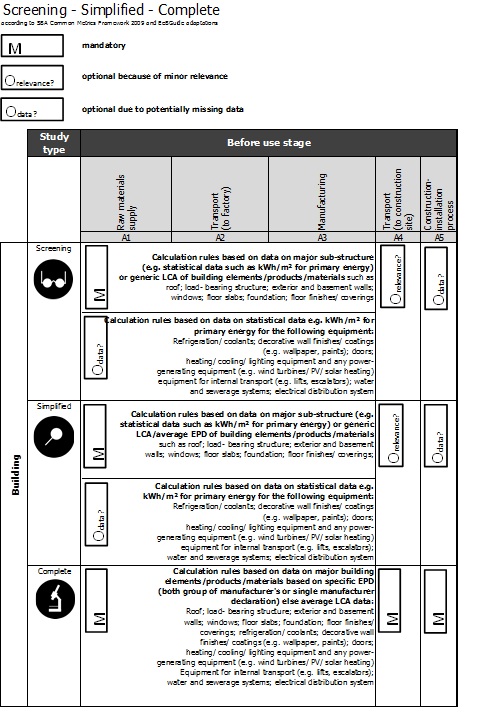
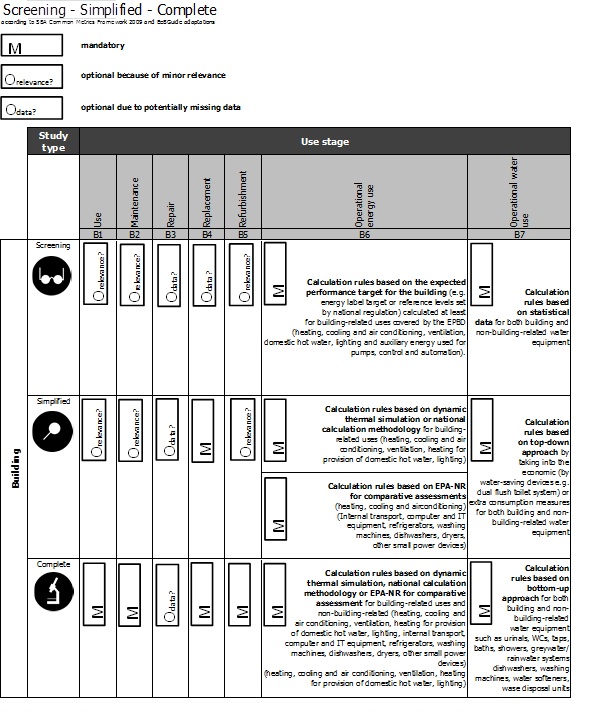
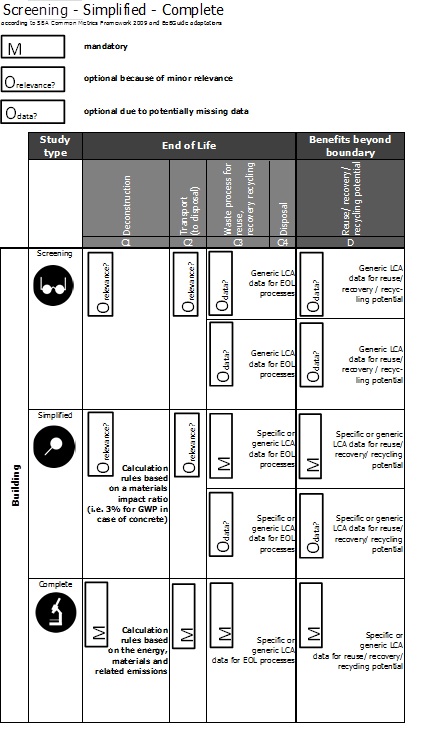
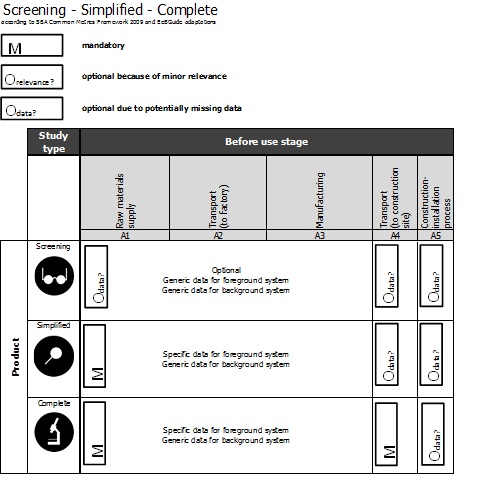
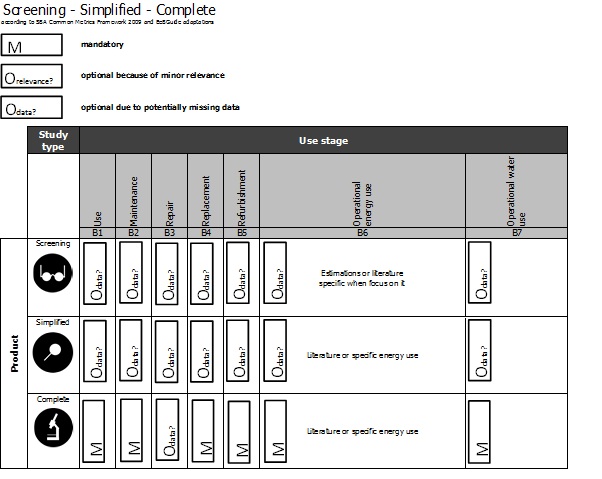
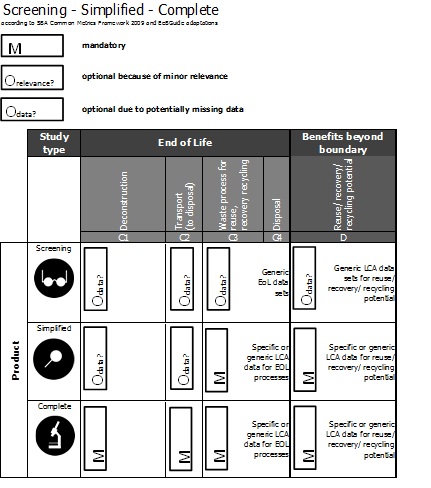
Table 5 gives specific information about how the three LCA study types (screening, simplified and complete) are currently implemented within the EeBGuide framework. Screening describes the first approach, where most of the information on the building is still very rough (e.g. within the design stage): thus default values of generic assumptions need to be chosen and used. In a simplified LCA study, detailed data are used, and a greater number of life cycle stages are addressed. Complete LCA reflects the most comprehensive and detailed application of the LCA methodology. For each level, Table 5 highlights those modules that are mandatory, optional because of their minor relevance, or optional because of currently missing data. The term ‘mandatory’ here specifically relates to projects of the Energy-Efficient Buildings Initiative (E2B EI). For other projects, or for the secondary audience of EeBGuide, this can be considered as a guideline.

Note: The term ‘product’ refers to building-related products, construction materials, components and services.

Table 5: Implementation of the different study types for buildings

3.2 How to conduct an LCA study within the field of energy-efficient buildings

Every LCA study generally follows ISO 14040 and ISO 14044, which provide general rules on how to conduct an LCA study – independent of the scope of assessment, type of product or associated industrial sector. They define the separate phases for such studies, and provide general rules for the application of this methodology. The defined phases are:

  • Goal and scope definition.
  • Life cycle inventory analysis (LCI).
  • Life cycle impact assessment (LCIA).
  • Interpretation.

Figure 7: Life cycle assessment framework according to ISO 14040/ ISO 14044

For LCA studies in the field of energy-efficient buildings, this approach is generally maintained. It is specified in more detail both in the ILCD Handbook and in CEN’s standards EN 15804 and EN 15978. Detailed descriptions of the steps that need to be addressed, following ISO 14040/14044, are defined in this guidance document.

The individual work items per step may vary, but to ensure that a study meets the basic requirements for LCA studies, every step has to be taken. So, for instance, the ISO 14040/14044 standards assume an LCA procedure that links elementary and intermediate flows (mass and energy flows that enter or leave a product system, e.g. as emissions to air) to unit processes. The development of the product model and the compilation of all these elementary flows take place during the life cycle inventory (LCI) step. If, as is frequently found in the construction sector, especially with EPD data, LCA data are provided using impact category indicators instead of elementary flows, the selection of environmental impact categories (to be defined within the ‘Goal and scope definition’ step), the life cycle inventory and life cycle impact assessment (LCIA) steps may already be completed by the data provider. The actual indicators evaluated in a study are therefore necessarily restricted, based on the available indicators listed for the data provided. In this context, it should be noted that, following EN 15804 and EN 15978, the LCIA steps are expected to be the responsibility of data providers (of background data or of specific EPD data).

So, if the LCA practitioner uses this kind of information source (i.e. EPD or LCA impact results), special care should be applied to ensure consistency between the calculations already made by data providers and those to be made by the practitioner. In particular, matching of the list of materials and quantities, often provided by the architect or construction company with the datasets available in the LCA database used, requires careful attention, and is frequently a challenge for the LCA practitioner. In addition, the use of EPD or LCA impact results should ensure that the same rules for LCI and characterization factors have been followed.


3     How to use this guidance document

3.2.1 How to start and proceed with an LCA study

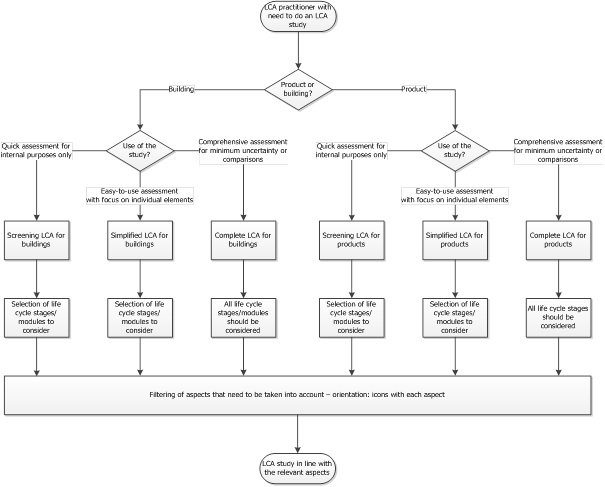
The first step, for both building and product LCAs, is to define the goal and scope of the study. This will determine the type of study that is required, and identify the relevant aspects that need to be considered. The decision tree shown in Figure 8 can help identify the type of study required for a given application.

The scope definition process will identify those life cycle stages that should be assessed, and those that will remain optional. It will also specify the data quality requirements and calculation rules (e.g. default values for screening LCA). Refer to Table 5 for identification of the mandatory and optional aspects (contributors and life cycle stages).

On the basis of the study type chosen and the life cycle stages of concern, the remaining relevant aspects are then taken into account during the set-up of the LCA building model, and when defining individual parameters of the system.

Figure 8: Decision tree to identify relevant aspects for a study

As the term ‘energy efficiency’ implies a lower energy input into a building or building service through a more advantageous benefit/input ratio, a comparison of the situation with or without the technology concerned may be required to identify the actual environmental consequences of utilizing such a technology. Careful definition of the two situations and a comprehensive life cycle view (inclusion of all relevant life cycle stages) are necessary to cover all the environmental consequences. Also, the comparison should be made on the basis of a common functional equivalent (i.e. a representation of the required technical characteristics and functionalities of the building or product).


3     How to use this guidance document

3.2.2 LCA study set-up: generic template

After selection of the study type and the subsequent filtering of aspects, the LCA study is set up according to general LCA practice, based on ISO 14040/14044. This process is briefly explained below with a generic template of how to set up an LCA study.

Step 1: Goal and scope definition

The definition of goal and scope relates mainly to the identification of study type and aspects considered for the LCA study, as described in section 3.2.1. Based on the goals of the study, and its intended application and audience, further specifications have to be made:

  • The object of the assessment (e.g. building, or innovative technology) and its function (e.g. office use, or energy-producing façade collector).
  • Definition of a functional equivalent – especially important for comparative assertions.
  • System boundaries – the life cycle phases to be included, depending on the study type or guidance for applying cut-off rules (e.g. with regard to infrastructure and transport), should be specified.
  • Procedure for allocation – several common allocation cases (e.g. for co-production, or reuse and recycling) with regard to mass, energy or environmental significance are required.
  • Choice of environmental impact categories, indicators and characterization models used for the impact assessment.
  • Data requirements and quality – the type of data to be used (e.g. generic or specific), data uncertainty, the use of foreground or background data (e.g. power mix) and specific data quality requirements for comparative assertions should be defined; missing data have to be documented.
  • Source of the data (origin, representativeness) and producer/sponsor of the LCA should be documented.
  • Assumptions and limitations – These may address, for example,. the set-up of specific scenarios for the use phase, the treatment of capital equipment or machinery within the production phase, or deviations from guidance provided within this document; a transparent documentation is required.

Examples and guidance on the above topics are provided within respective aspects of Section 5.2 ‘Goal and scope definition’ in this guide.

Step 2: Inventory analysis and product model

The method of data collection and the quantification of input and output flows (e.g. materials or energy) differ for screening, simplified and complete LCA studies, and depend both on the complexity of the product being assessed and on the assessed life cycle stages. The data sources used (e.g. publicly available or company/product-specific ones) and the quality of background data for the inventory analysis also have an influence on the impact assessment. Guidance on data collection, calculation, validation, and relating the information to e.g. life cycle stages or elements of the object of assessment. is provided in Section 5.3 on ‘Life cycle inventory analysis‘. Building and building product contributors that have to be considered are also defined. By using generic data or EPD as a data source for building LCAs, LCA practitioners typically do not need to perform the inventory analysis. Normally, therefore, none of the construction elements is individually modelled back to the elementary flows.

Step 3: Impact assessment

For quantifying potential environmental impacts, it is important to choose both environmentally relevant, technically and scientifically valid environmental indicators and the underlying characterization models for impact assessment. Environmental indicators and impact categories for which scientific consensus is not yet reached (e.g. water consumption, land-use change, toxicity and ecotoxicity or carbon sequestration) are addressed within Section 5.4 on ‘Life cycle impact assessment’.

Step 4: Interpretation and documentation

The interpretation of results serves, for example, to identify hot spots (e.g. distinct life cycle phases or elements of the object of assessment contributing to environmental impacts), and provides understanding of the sensitivity and uncertainty of the results. Requirements for and guidance on the use of normalization, grouping or weighting are provided in the sections on ‘Interpretation’. Cases where a sensitivity analysis is useful are also defined.

Step 5: Review

An external critical review is necessary for all comparative LCA studies, and for studies that are made publicly available. Guidance on simplifications for the review of stand-alone and screening LCA studies, and for studies within the E2B EI, is provided under the section ‘Reporting’ in Chapter 5 on ‘General aspects’.

Reporting and review templates are provided online at the official project website, and these are particularly helpful with step 1. They form the basis for documentation that is in line with the present guidance document, and which might be enhanced with further specific information if required or recommended (e.g. if future technologies and innovations are considered).


3     How to use this guidance document

3.3 Compliance with this guidance

As this guidance is intended to be used both within EeB research projects and by building LCA tool developers, to increase confidence in LCA for decision support and to increase reliability in LCA results, practitioners are able to claim compliance with the EeBGuide only if several prerequisites are met:

  • Compliance with the individual provisions given for the relevant aspects.
  • Documentation of the LCA study by using the reporting template provided.
  • Review according to the EeBGuide review requirements.

Review requirements

Any study that claims compliance with this guidance requires an independent review. A review in this context is the evaluation of an LCA study by experts who are independent in the sense that they did not take part in the study. A review serves to ensure the quality of a study and thus increase confidence in its results, and in its usefulness as a decision support tool. Specifically, the review is used to ensure that the rules of this guidance are followed, and that the consequences (choices of parameter values, etc.) are reasonable from a technical perspective. For a pragmatic approach to conducting a review, review schemes in the form of checklists are provided within this guidance. These review schemes also contain the distinction between screening, simplified and complete LCA studies.

Critical reviews of LCA studies are defined and required in ISO 14040/14044 for comparative assertions that are intended to be disseminated to the public. Within the context of this guidance, any comparative assertion requires a critical review according to the requirements of ISO 14044. The, major requirements are that:

  • The critical review is conducted by a review panel of a minimum of three independent experts.
  • The panel chair must be an LCA expert with previous experience in critical review.
  • The panel must contain a minimum of one technical expert from the field of the assessed product system and a minimum of one LCA expert.
  • The panel must contain an expert on the impact categories relevant to the product system under study.
  • The review report is attached to the study report.

For LCA studies within a European research project the review mught be done by one member of the consortium (especially if contractual constraints do not permit the commissioning of an external expert to do the review), but they should not be directly involved in the preparation of the study. The ILCD Handbook also defines requirements for reviewers, especially related to their independence, qualification and experience.

More specifically, for LCA studies that claim to comply with this EeBGuide, reviewers need to:

  • Have expertise in LCA methodology, and specifically be familiar with the rules of the EeBGuide
  • Have knowledge of the applicable review rules, and specifically be familiar with the EeBGuide review schemes
  • Have review or verification experience
  • Have expertise in the product or process in question, and specifically experience in the respective building type or product category

If, for particular reasons, the review process requires greater focus, or is used to improve the reliability of the study results in the context of public or external dissemination, it is recommended that practitioners consult the ILCD Handbook for additional information, in the sections Review schemes for life cycle assessment (LCA) and Reviewer qualification for life cycle inventory datasets.


3     How to use this guidance document

3.4 How to proceed with the service life assessment in building and product LCA studies

This section introduces the main concepts of service life planning. These are useful for practitioners who intend to carry out an LCA study for product and building

One characteristic of LCA studies in the construction sector is the assessment of technical systems that often have very long service lives. Estimations of service lifespans of one or more decades are typically more difficult to oversee than the service lifespans of consumer products, for example. As a consequence, and depending on other parameters, estimations of the service life of buildings and products may have a major influence on the LCA results. In this context, the concept of service life planning, which is closely related to [ISO 15686], and which is frequently cited in EN 15804 and EN 15978, is a relevant and very general aspect of LCA in the construction sector. An introduction to service life planning is therefore given in this section.

There is a considerable momentum behind initiatives to provide the construction sector with methodologies, tools and standards for service life planning and sustainable construction. This EeBGuide can be regarded as a further example of this movement. The following gives a brief introduction to service life planning, as an area derived from scientific research on service life prediction for materials and products. Service life planning of construction works aims to support an approach to engineering of technical systems that meets the requirements of a life cycle perspective on the overall system.

What is service life planning about?

Buildings are normally expected to be long-lived engineered works. As for any other technical system, they are designed to meet expected requirements over a foreseen lifetime. How, then, should these requirements be expressed, and how can the essential properties of the engineered system be optimized to ensure that the requirements are met? Buildings offer an extra complication, as the long service life will often include a shift or change in performance requirements with time.

Service life planning offers a systematic approach to this process, and over the past two decades standards as well as other tools for life cycle engineering have been developed. A service life planning assessment of a building may be performed for limited technical and economic reasons, but since the end of the 1980s environmental concerns and sustainability in construction have typically been the main driving forces.

A European perspective

The Construction Products Directive (CPD) was created with the aim of removing barriers to trade, and in this specific area it has little direct reference to sustainability. However, it has a clear bearing on the performance of buildings (construction works) over time, and provides important direction for international, European and national work on standards and codes. The CPD fixes the essential requirements for construction works (both buildings and civil engineering works).

These requirements must, subject to normal maintenance, be satisfied for an economically reasonable working life. This horizontal requirement of the CPD presupposes a service life planning assessment of the construction works. The works should be designed for an anticipated design life (working life), and the service life planned by being composed of service life declared products.

The CPD has an aim of connecting the building and the building products put on the European market and used in these works. It therefore specifies the level of performance of these products: they “have such characteristics that the works in which they are to be incorporated, assembled, applied or installed, can, if properly designed and built, satisfy the essential requirements.” This is the notion of ‘fitness for the intended use’ of a building product. The link between the essential requirements of the works and the product characteristics to be assessed is fixed in Interpretative Documents (IDs) [Guidance Paper F 2004].

Figure 9: The working life of construction works as illustrated in the CPD Guidance Paper on Durability [Guidance Paper F 2004].

The CPD further specifies that a building product is fit for its intended use if it conforms to: (i) a harmonized European standard (drafted by CEN/CENELEC), (ii) a European Technical Approval (issued by an EOTA [CEC 1988] member), or (iii) a non-harmonized technical specification (e.g. a national technical specification) recognized at Community level; the three are denoted as technical specifications. According to the CPD: “The products must be suitable for construction works that (as a whole and in their separate parts) are fit for their intended use, account being taken of economy, and in this connection satisfy the following essential requirements where the works are subject to regulations containing such requirements. Such requirements must, subject to normal maintenance, be satisfied for an economically reasonable working life.” Furthermore, the Interpretative Documents provide that product standards and Guidelines for European Technical Approval (ETAGs) “should include indications concerning the working life of the products in relation to the intended uses and the methods for its assessment.”

The CPD is being revised and elevated to the level of a regulation, Construction Products Regulation (CPR), which is expected to be implemented by July 2013. With CPR’s sustainable use of resources added as the seventh basic requirement (renamed ‘essential requirements’) for construction works, service life planning is likely to gain even more significance in the European construction context.

Standards for service life planning

ISO standardization (ISO TC59/SC14) to support service life planning started in 1993, when a working group was established through a significant European initiative. Guiding concepts were needed regarding the service life of building products to help implement the Construction Products Directive. As the subject area was rightly seen to have international relevance, ISO work became based on cooperation with CEN.

The scope of ISO TC59/SC14 is to document the steps to be taken at various stages of the building life cycle, to ensure that the resulting building (or other constructed facility) will last for its intended life without incurring large unexpected expenditures.

The concept

A building (construction work) is designed for a certain design life (working life). Building parts not accessible from a technical and economical point of view should be designed for the same service life as the building. Other building parts and products may have a shorter, but declared, service life (see Figure 10).

Figure 10: the service life planning concept


Service life planning standards

The ISO 15686 standards (see Table 6) give guidance on all aspects of service life planning (SLP). Part 1 gives the general design principles and procedures of SLP, whereas Part 8 describes the requirements for reference service lives (RSL) of products and components.

The RSL should be used and adjusted in the design process to establish the service life of a product/component in a particular use or design situation. The Part 8 standard also provides guidance on methods to be used in the design process for this adaptation of an RSL. These methods and models are described under the generic name the factor method, but comprise a set of approaches, from simple checklist adjustments, through multiplication methods, to more advanced (but not necessarily more complicated) functional models.

Who provides reference service lives?

This has been an essential question and point of discussion all through the standardization work. The conclusion – and solution – is that the responsibility for providing RSLs for products lies mainly with the producers of the products in question. Research should be undertaken to support these RSLs with methodologies, i.e. how to test and declare a reference service life, and the ISO 15686 standards provide examples. Publicly initiated and funded databases have appeared, and may be significant drivers of progress, but will most likely have less influence than market-driven and developed initiatives.

Table 6: The ISO 15686 standards, with the general title Building and constructed assets – Service life planning, includes the following parts

Standard

Subject

ISO 15686-1 General principles Provides general design principles and procedures for planning the service life of buildings and construction works
ISO 15686-2 Service life prediction procedures Describes a procedure that facilitates service life predictions for building products and components
ISO 15686-3 Performance audits and reviews Describes the approach and procedures to be applied to pre-briefing, briefing, design, construction, life care management, and disposal of buildings and construction works
ISO/AWI 15686-4 Data requirements Technical specification describing the data requirements needed to carry out service life planning, considering various service environments and other in-use conditions. In cooperation with the International Alliance for Interoperability (IAI), the aim is also to describe IFC compliance for the ISO 15686 series
ISO 15686-5 Life cycle costing Provides guidance on developing a model of capital and running costs of a project, so that the overall costs can be assessed, and how this data can be used for financial appraisal
ISO 15686-6 Procedure for considering environmental impacts

Standard providing guidance on assessing the relative environmental impacts of alternate service life designs, and identifying the interface between environmental LCA and service life planning
ISO 15686-7 Performance evaluation for feedback of service life data from practice A generic basis for performance evaluation and feedback of service life data from existing buildings and construction works
ISO 15686-8 Reference service life and service life estimation

Describes how to provide, format and extract reference service lives of components, etc., to establish their service life in a particular application. It also provides the factor method to carry out such estimations.
ISO/TS 15686-9 Guidance on provision of reference service life data

Guides building products manufacturers and standard writers on addressing durability and service life declarations in product standards. The work was performed in cooperation with CEN TG on durability, supporting European product standards.
ISO/CD 15686-10 Functional performance Provides process guidance for managing the capability of a constructed asset through the service life of that asset to meet the stated levels of requirements.


3     How to use this guidance document