G-04 Comparative assertion for building or product LCA
| Aspect | G-04 Comparative assertion for building or product LCA | |||||||||||||||
 Description |
Comparative assertion is an environmental claim regarding the superiority or equivalence of one building product (or one building design) compared with a competing building product (or an alternative building design) that performs the same function. Usually, the comparison of alternative products, systems or buildings is the main goal of a comparative LCA study. Different aspects have to be taken into account to conduct a meaningful and robust comparative assertion. One of these is the functional equivalence between the systems under comparison (see the ‘functional equivalent’ aspect), but there are other aspects that need to be considered, such as the system boundary, the background database, the life cycle inventory, and the life cycle impact assessment methodology applied. How can a comparative assertion be made in building LCA applications? |
|||||||||||||||
|
Related study objective |
☐ stand-alone LCA | ☒ comparative assertion | ||||||||||||||
|
Related study phase |
☒ goal and scope definition |
☐ inventory analysis (LCI) |
☐ impact assessment (LCIA) |
☐ interpretation |
☐ reporting |
|||||||||||
| Relevant for |
 new buildings |
 existing buildings |
 construction products |
 screening LCA |
 simplified LCA |
 complete LCA |
||||||||||
 Provisions |
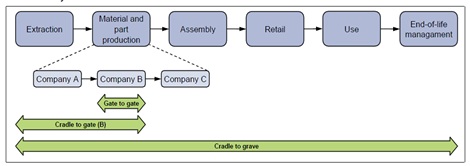
In a comparative study, it must be ensured that the systems being compared are equivalent in function. According to ISO 14044 and ILCD, the same functional unit, system boundary, data quality requirements and allocation procedures have to be applied. EN 15978 provides the practitioner with rules to be considered in the comparison of two buildings. The comparison also has to use the same environmental indicators, using those defined in the standard and in the ILCD Handbook. The provisions of EN 15804 may be used under very specific conditions to compare cradle-to-grave product alternatives (cf. guidance). |
|||||||||||||||
 Rules from |
Main provisions for all comparative studies (summary of the ILCD Handbook):
Main provisions for studies with similar functional equivalent (summary of the ILCD Handbook):
|
|||||||||||||||
 Guidance |
For building LCA applications, comparative assertions are typically conducted to choose among design alternatives.
The major focus of the LCA practitioner has to lie on defining two alternatives that are truly comparable. Therefore special attention should be directed to identifying all functions that a design alternative has. This may include technical functions, e.g. structural functions, and building physical functions, such as ensuring specified quality levels of the indoor environment, but also architectural and aesthetic functions. Therefore design alternatives should always be agreed within the planning team, including the architect, structural engineers, building physics and energy performance experts. If the functions of two design alternatives are not truly comparable, the planning team should identify additional solutions to ensure comparable features, and these should be included in the comparative LCA study. Users who are not LCA experts typically use dedicated LCA tools for comparing their building’s design alternatives. Such tools may support the choice of adequate – comparable – design alternatives, and assist in conducting the LCA study, especially with regard to the comparability of background data, etc. 1) Practical guidance when comparing building design alternatives Concerning the background database used for the comparative assertions, the user can look at the methodological report or user manual of the LCA software for buildings to check for consistency according to the ILCD handbook. 2) Comparative assertion for product LCA based on EN 15804 in E2B EI research projects |
|||||||||||||||